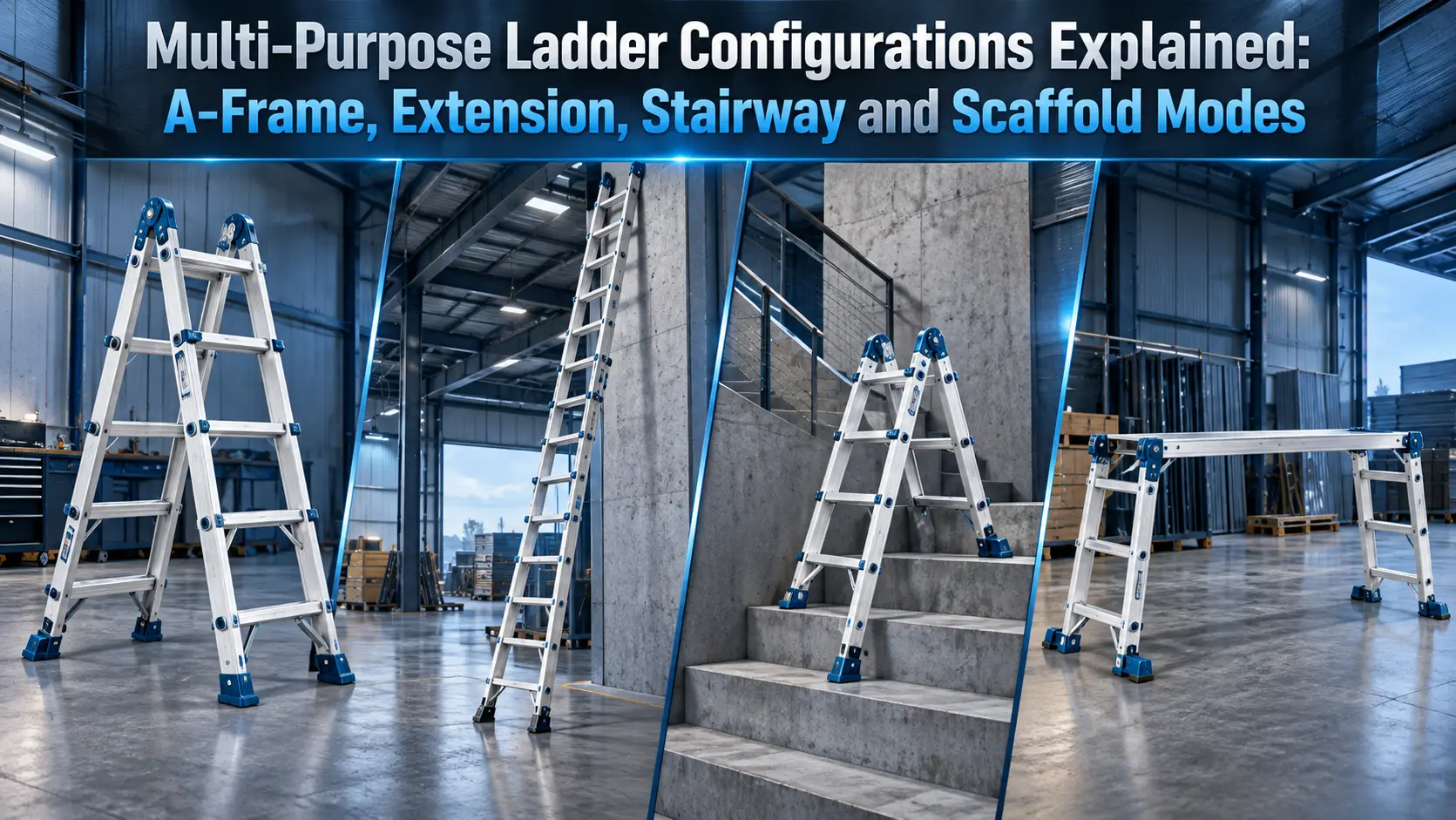
For contractors and access-equipment buyers, multi purpose ladder configurations are not simply folding options. Their value comes from using one product in more than one approved arrangement. A-frame, extension, stairway and scaffold-style arrangements can make a fleet more adaptable, but only where the exact model, its labels and its instructions allow that configuration.
Fine Ladder offers aluminum and fiberglass multi-purpose ladders with multi-angle locking hinges and compact folding designs. Before a buyer treats any configuration as part of a product specification, confirm it against the model’s operating manual and the requirements of the destination market. Names also vary: a multi-position ladder, combination ladder and folding ladder may describe related products, but they do not guarantee identical functions.
This guide explains common multi purpose ladder configurations, suitable tasks and key buyer checks.
| Configuration | What it looks like | Typical task fit | Key confirmation before use |
|---|---|---|---|
| A-frame | Two ladder sections form a self-supporting inverted V | Interior repair, painting, retail maintenance and short access tasks on level ground | Hinges are fully engaged; feet are level; model is approved for self-supporting use |
| Extension / leaning | Sections form a straight or near-straight ladder supported at an upper point | Wall, façade, roof-edge or elevated-access work where a secure support exists | Correct upper support, approved length and all locks/pins set as the manual requires |
| Stairway | Sections are set at different heights to suit a staircase or stepped area | Stairwell painting, maintenance and installation where the model expressly permits it | Each side is supported correctly; hinge positions and site restrictions are verified |
| Scaffold-style | Ladder sections support a work platform or plank arrangement | Repetitive low-level work only when the product system is expressly designed for it | Manual, compatible components, platform instructions and local work-at-height rules all permit it |
The table is a selection aid, not a universal operating instruction. A configuration shown on one product may be unavailable, prohibited or differently limited on another. HSE similarly advises users of combination and multi-purpose ladders to follow the manufacturer’s instructions, particularly for locking devices and the intended configuration.
In A-frame mode, hinged sections create a stable, self-supporting shape. This is often the most familiar configuration for buyers because it supports tasks where there is no suitable wall or vertical face to lean against. Typical examples include ceiling-adjacent maintenance, internal painting, warehouse repairs and service work around shelving.
The purchasing question is not merely whether the ladder folds into an A shape. Ask whether both climbing sides are intended to be used, which standing areas are permitted, whether a spreader or secondary lock is used, and what the product label says about the configuration. A buyer should also request clear images or video showing the hinges in their locked position. Fine Ladder’s multi-purpose ladder range is a useful starting point for comparing available aluminum and fiberglass options.
Place feet on a firm, level base, keep hinges locked and never change the shape while anyone is on the ladder. A-frame mode does not make a ladder a work platform; task demands and local rules still matter.
An extension configuration aligns sections for access to a higher point. It can be useful for exterior maintenance, access to a wall-mounted service point, cleaning or repair work, and some construction tasks. Buyers may hear “A-frame extension ladder” used informally, but it is clearer to distinguish the self-supporting A-frame arrangement from a straight, supported extension or leaning arrangement.
This mode requires a secure upper bearing point and an approved setup method. Product instructions govern the usable length, overlap or rail arrangement, locking points, footing and contact surface. The correct angle and access-above-landing rules can also differ by jurisdiction and task. Do not specify a universal angle, overlap or reach figure in a catalogue unless it is verified for that model and market.
Assess extension capability alongside closed length. Record folded dimensions, carrying weight, hinge operations and conversion time during sample evaluation.
Stairway mode uses independently positioned ladder sections to accommodate a difference in floor level. It is relevant for stairwell decorating, lighting work, handrail repairs and maintenance in split-level buildings. The appeal is clear: it can reduce the need to improvise with blocks, loose packing or an unsuitable conventional ladder.
That appeal also makes this configuration easy to overstate. A ladder for stairs must be specifically designed and labelled for the arrangement. The hinges must lock in the prescribed positions, both feet must be correctly supported, and the user must consider stair width, landing space, traffic and the height of the task. Never assume that every multi-position ladder can be used on stairs just because its sections articulate.
For wholesale specifications, request a configuration diagram, permitted hinge positions, rail-section instructions and approved stairway-orientation photographs. This prevents a generic “works on stairs” claim entering a listing.
Some multi-purpose ladders are designed to support a scaffold-style arrangement with compatible platform components. This can be attractive for repetitive, low-level tasks such as wall preparation or interior finishing because it may provide a different working position from a ladder. However, scaffold-style must never be treated as an automatic fourth mode for every combination ladder.
Use it only where the product documentation explicitly describes the configuration, names the compatible components and states the setup process. The platform, supports, locking points, access method and any edge-protection requirements are matters for the model instructions and applicable local work-at-height rules. A loose plank or a platform from another system is not an acceptable substitute.
Rental and dealer buyers should obtain complete documentation before listing this capability. If local rules treat it as a scaffold or work platform, requirements may exceed those for a portable ladder.
Build these checks into user guidance, rental handover and incoming inspection:
This checklist does not replace training or local requirements.
During sample approval, evaluate the hinge assembly as carefully as the rails:
Fine Ladder’s product videos can begin product discussions; final decisions should rely on exact model documentation and samples.
Aluminum multi-purpose ladders can be a practical option where portability, general trade work and corrosion considerations shape the purchase. Fiberglass rails may be considered for work environments with potential electrical exposure, subject to the specific product condition, contamination, moisture, damage, training and local safety requirements. Fiberglass is not a blanket assurance of electrical protection, and neither material choice removes the need to identify hazards before setup.
Rather than stocking one material for every account, distributors can create a focused mix: aluminum configurations for general building, maintenance and rental demand; fiberglass configurations for customers whose work environment and procurement requirements call for that material. Confirm the target-market requirements before assigning any electrical or performance claim to a listing.
Multi-purpose ladders are often selected partly because they fold compactly. Buyers should nevertheless test the complete logistics path, not only the folded product on a showroom floor. Check closed dimensions against vehicle racks, van interiors, warehouse bays and last-mile delivery limits. Confirm how the hinges are protected during transit, whether feet and locks can rub against adjacent units, and whether the packaging prevents movement inside a carton or pallet.
For a bulk order, request folded dimensions, weights, carton marks, pallet pattern, loading photos and the packaging specification. After realistic handling, operate every hinge, confirm lock engagement and check labels for abrasion.
Start with customer tasks rather than the largest possible list of modes. A building-maintenance customer may prioritize compact A-frame and extension capability. A stairwell contractor may value an approved stairway arrangement. A rental operation may prefer models with simpler, repeatable conversions and clearly documented inspection points. A retailer serving DIY customers may need more visual instructions and a more selective range.
| Buyer question | What to request from the supplier |
|---|---|
| Which modes can we sell? | Model-specific diagram and instruction manual, not a generic category description |
| Which materials suit our accounts? | Rail material details, use-case guidance and target-market documentation |
| Will it fit our logistics? | Folded size, carton size, packing method and loading data |
| Can staff demonstrate it? | Training video, hinge/lock explanation and sample unit |
| Can we support rentals or repeat sales? | Incoming-inspection points, care guidance and confirmed spare-parts policy |
Before placing an order, ask Fine Ladder to review the required configurations, material, working height, packaging format and destination market. The contact team can help start a model-specific discussion rather than a one-size-fits-all ladder recommendation.
The best multi-purpose ladder configuration is the one that matches an approved product setup to a real task, work environment and transport plan. A-frame, extension and stairway modes can solve very different access problems; scaffold-style mode requires even tighter confirmation of the product system and local rules. For professional buyers, reliable hinge engagement, clear instructions, sample testing and disciplined product claims are what turn flexibility into a practical range decision.
No. Capabilities vary by model. Confirm every permitted configuration in the ladder’s labels and operating instructions before buying, listing or using it.
Clear the ladder, inspect hinges and rails, confirm the approved configuration, fully engage every required lock and check the supporting surfaces before climbing.
Only if the exact model is designed, labelled and instructed for a stairway configuration. Stair geometry, support points and local requirements must also be suitable.
Not necessarily. It must be assessed according to the exact product system, compatible components, manufacturer instructions and local work-at-height rules.
Test each approved configuration, hinge engagement, folded size, transport protection, labels, packaging, documentation and the target-market fit before confirming a bulk order.