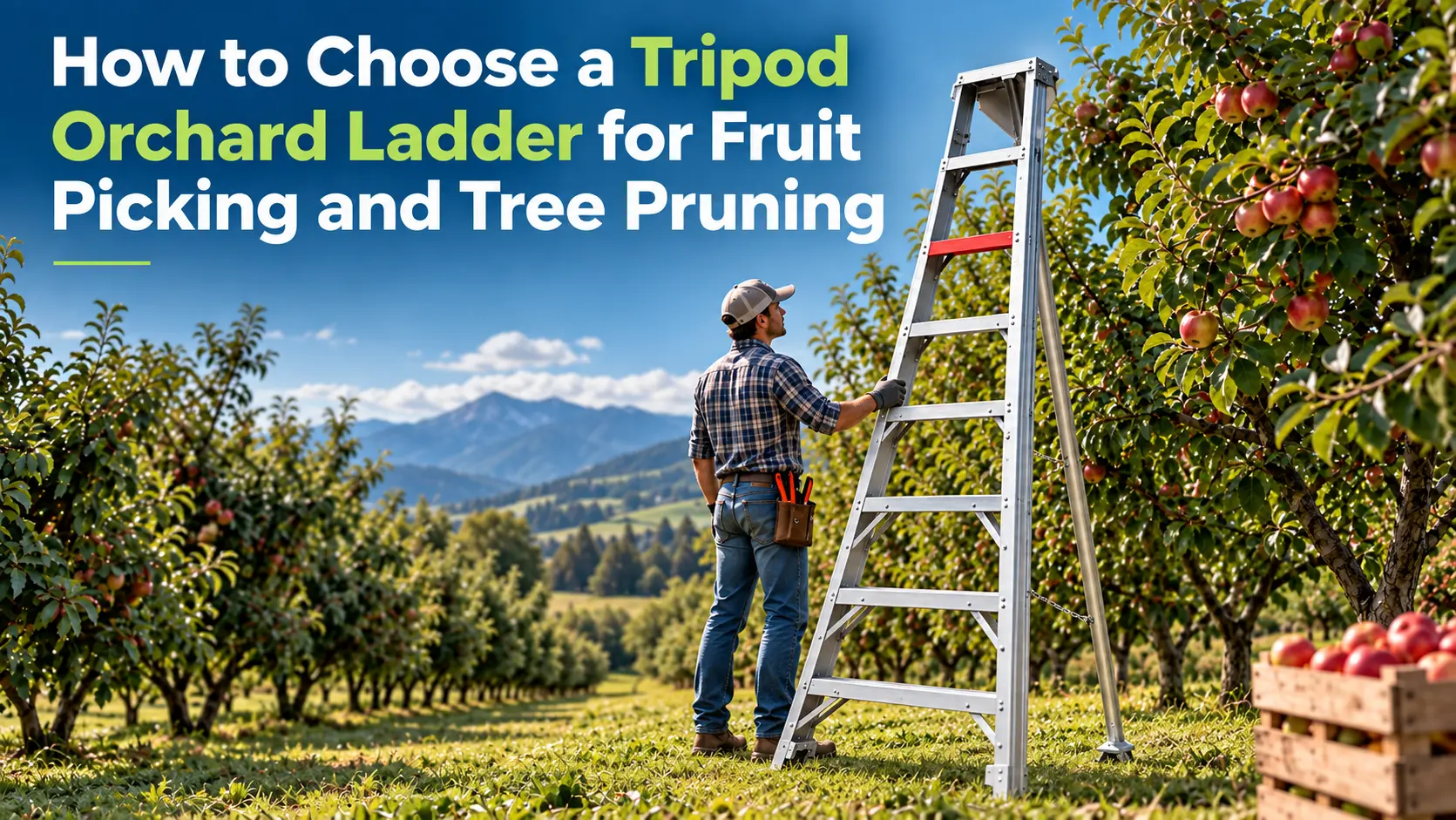
A tripod orchard ladder is designed for a different working environment from a ladder used on a finished floor. Fruit picking and tree pruning bring uneven ground, soft soil, root zones, branches, repeated repositioning and the need to work close to a canopy. For those conditions, the shape of the ladder, the support arrangement and the way it travels through an orchard are as important as its nominal height.
For importers and professional buyers, the right choice starts with the orchard rather than a catalogue name. Assess the tree type, planting layout, ground condition, usual picking height, transport method and destination-market requirements. This guide explains what to inspect in a tripod fruit picking ladder and how to build a more dependable product specification.
An orchard ladder commonly uses two front legs and a third, rear support leg. On natural ground, three contact points can be easier to position when one area of soil is lower, softer or interrupted by roots. The rear leg allows the user to place the ladder closer to the working side of a tree while maintaining a defined support shape—when the product is set up as instructed.
That does not mean a tripod ladder is suitable for every slope, every soil condition or every tree row. Ground can shift, sink, become slippery or conceal holes. A three-leg arrangement must still be checked for stable contact, clearance from hazards and a suitable working position. If the terrain, weather or task makes the setup uncertain, the work plan may require another access method.
A four-leg ladder can feel familiar on level, firm surfaces, but all four feet need dependable support. On non-paved orchard ground, one foot may lose contact or create rocking. Neither format is automatically better in all circumstances. The decision should be based on the specific orchard, work method and approved product instructions.
The third leg is a defining feature of a tripod ladder. Buyers should ask where it sits relative to the climbing section, how it opens or locks, how it is protected in transport and what the user instructions say about positioning it near a tree canopy. The aim is not simply to reach further into branches; it is to create an approved stance that can be checked before climbing.
During sample review, open and close the third leg repeatedly. Check for smooth, controlled movement, secure retention in the folded position and clear setup information. Examine joints, fasteners and any locking or bracing parts for consistent fit. Ask the supplier for the current operating instructions rather than inferring allowable positions from product photographs.
In orchard use, the rear support should be placed deliberately, not pushed into whatever soil is available. Check for buried irrigation lines, loose mulch, wet ground, roots, stones and low branches that could interfere with full deployment. Never invent a foot insertion depth, leg angle or ground-slope limit where the model documentation does not give one.
| Selection point | Tripod orchard ladder | Four-leg ladder |
|---|---|---|
| Contact geometry | Three support points with a rear leg positioned for the canopy-side task | Four feet requiring even, stable contact |
| Orchard positioning | Can be practical around trees when the model is set up correctly | Often better suited to more level, open working areas |
| Ground check | Each foot and the rear leg location need assessment | All four feet must be checked for firm contact and rocking |
| Buyer focus | Rear-leg operation, feet, joints, folded profile and instructions | Foot contact, spreader or braces, footprint and transport |
This comparison describes selection considerations, not a setup rule. The manufacturer’s instructions, local requirements and a site-specific assessment always take priority.
Tree pruning ladder buyers should inspect the climbing interface and ground interface together. Steps should be clean, undamaged and appropriate for the intended footwear. Request details of step profile, attachment method and inspection guidance, but do not claim anti-slip performance, dimensions or ratings unless they are verified for the exact model.
Feet deserve equal attention. They face abrasion, mud, moisture, stones and repeated loading during harvest. Check how they are attached, whether replacement is possible under the supplier’s confirmed policy, and how users should inspect them. A foot that is worn, missing or contaminated can change the stability of either a tripod or four-leg ladder.
For distributors, include feet, steps and labels in incoming inspection. A carton may arrive undamaged while a foot is distorted or a step has been scraped in transit. Photograph the condition of a sample before and after a practical handling review, particularly if units will be shipped through multiple agricultural dealers.
Fine Ladder’s other ladder range includes riveted and welded aluminum fruit-ladder options. These are construction categories, not a shortcut to a performance claim. Compare the exact product drawings, component joins, finish, intended application, labels and documentation before deciding how to position either type.
For a riveted aluminum fruit ladder, inspect the consistency of rivet installation, surrounding material condition, alignment and any movement at joints. Look for damage, sharp edges, loose components or corrosion. For a welded aluminum fruit ladder, inspect weld appearance, consistency, adjacent material condition, alignment and protection from shipping damage. Do not make claims about strength, lifespan or load capacity without model-specific evidence.
The commercial question is how construction supports your market’s expected use, service process and merchandising. A rental operation may emphasize documented incoming checks. An importer may prioritize carton protection and repeatable assembly quality. A specialist orchard dealer may need a clear explanation of the rear leg, feet and transport profile more than a broad generic “heavy-duty” claim.
Aluminum orchard ladders are often evaluated for handling and outdoor service, but conditions still matter. Fertiliser, wet soil, chemicals, salt air, orchard sprays and storage moisture can affect the product or leave contamination on steps and joints. Follow the manufacturer’s cleaning and care guidance, remove contamination promptly where instructed, and inspect the ladder before seasonal reissue.
Do not market aluminum as maintenance-free. Buyers should request cleaning guidance, storage instructions and any limitations stated by the supplier. Store ladders where they are supported, protected from impact and not used as racks for other equipment. Before harvest, check feet, steps, joints, labels and the third-leg mechanism again rather than relying on the prior season’s inspection.
The best aluminum orchard ladder for one buyer may be inconvenient for another if it does not match transport. Consider whether workers carry the ladder by hand between trees, load it onto a utility vehicle, place it on a trailer or stack it for delivery. Record closed dimensions, handling method, protective packaging and the risk of the third leg catching on branches, racks or adjacent ladders.
For bulk procurement, request unit and carton dimensions, packing orientation, pallet plan and loading photos. Test a sample in the expected route: from storage to vehicle, through a row, around a tree and back to storage. This practical review often reveals whether folded profile, handholds and packaging are fit for the local orchard operation.
Use the following questions when comparing a fruit picking ladder range:
Avoid stocking only by maximum height. A balanced range may include several heights matched to common crop and canopy needs, while keeping the construction, feet, rear-leg arrangement and transport profile clear for sales staff. Use model-specific manuals and images so that a customer understands what the product is designed to do—and what it is not designed to do.
Before a first order, review a physical sample, packaging and all supporting documents. Fine Ladder can discuss specifications when buyers provide their tree species, terrain, usual working height, transport method and target market through its contact page. This produces a more useful selection conversation than choosing a ladder only from a product image.
The right tripod orchard ladder is an orchard-specific decision. Assess the third leg, feet, steps, construction, corrosion exposure and transport route against the actual fruit-picking or pruning task. Three-leg geometry can help on natural ground, but it does not remove the need for a stable setup, correct instructions and a continuous ground check. For buyers, detailed product information and sample inspection are the foundation of a credible orchard-ladder offer.
Three contact points can be practical on natural ground and allow a rear support leg to be positioned for canopy work. Suitability still depends on the exact model, ground condition and manufacturer instructions.
Not automatically. Do not assume any ladder is suitable for all slopes or soil types. Assess the site and follow the product instructions and local work-safety requirements.
Check rivet consistency, alignment, surrounding material, joints, feet, steps, labels and shipping condition. Confirm product-specific specifications with the supplier.
Review weld appearance and consistency, adjacent material condition, alignment, feet, steps, labels and packaging protection. Avoid performance claims that are not verified for the model.
Provide tree species, terrain, usual working height, transport method, target market, expected user type and any packaging or documentation requirements.