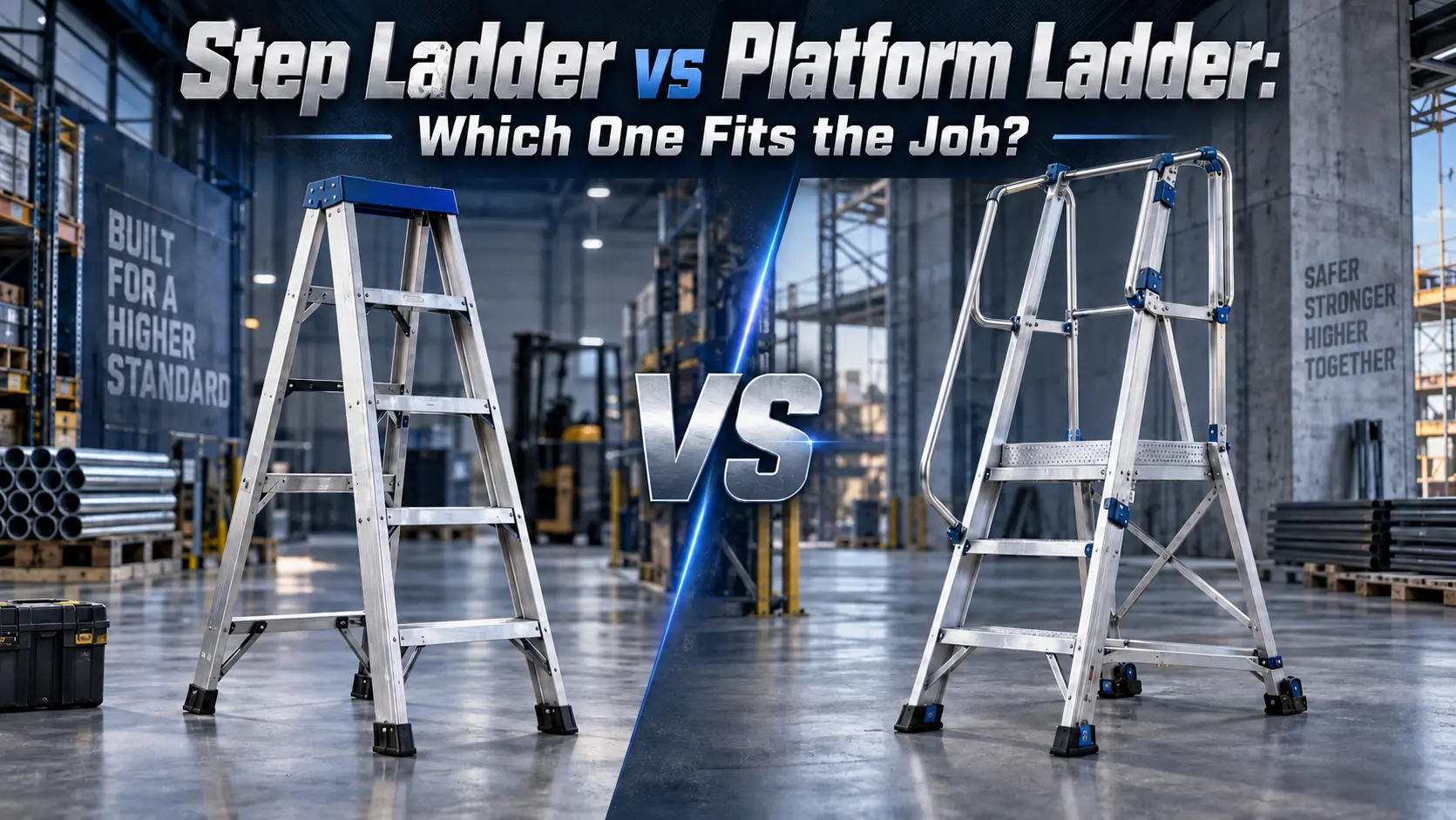
In a step ladder vs platform ladder comparison, the right choice depends on the task, work position, duration, tools, available floor space, and how often the equipment must be moved. A standard step ladder is often a practical choice for brief, mobile tasks. A platform ladder can provide a defined standing surface and, depending on the design, a handrail or guard structure that may better support tasks requiring a steadier working position.
Neither format is automatically right for every workplace. A platform does not make prolonged work risk-free, and a lightweight step ladder should not be chosen only because it is easy to carry. Buyers must match the exact product to a risk assessment, manufacturer instructions, user competence, and applicable local requirements.
This guide helps warehouses, retail facilities, contractors, industrial buyers, importers, and distributors compare the two categories without relying on vague product labels.
| Selection factor | Standard step ladder | Platform ladder |
|---|---|---|
| Typical task profile | Brief access, inspection, retrieval, and light maintenance | Tasks benefiting from a defined standing area and more stable work position |
| Standing surface | Individual steps; standing restrictions depend on the model | Dedicated platform when opened and locked correctly |
| Hand support | Top cap, rail, or other support varies by design | May include a higher handrail or surrounding structure, depending on the model |
| Tool handling | Often relies on a tool belt or model-specific tray | May offer a tray or storage feature, but capacity and permitted use must be confirmed |
| Movement | Often lighter and quicker to reposition | May be heavier or bulkier because of the platform and supporting structure |
| Floor space | Commonly suitable for smaller work zones | May require a larger open footprint and more setup clearance |
| Work posture | Suitable when the user can face the task and avoid overreaching | Can support a more defined standing position but does not remove posture or reach limits |
| Fleet role | High-mobility, general-purpose access | Repeated tasks at a defined working zone or position |
Compare actual models rather than category averages. Dimensions, weight, platform size, permitted standing position, feet, spreaders, rails, tray design, material, labels, and duty information can vary substantially.
“Step ladder,” “platform ladder,” “platform stepladder,” “podium,” and “mobile ladder stand platform” do not always mean the same thing across markets.
For procurement, replace the label with a technical description. Request drawings showing the standing surface, access steps, handrails or guards, spreaders, hinges, feet, deployed footprint, closed dimensions, and permitted use. A familiar name is not proof that two products have the same function.
A conventional step ladder often fits short, light tasks that involve climbing, completing a limited action, and returning to the floor. Examples may include visual checks, changing a display, retrieving a small item, or performing brief maintenance—provided the risk assessment supports ladder use.
A platform ladder may be more appropriate when the worker needs a defined standing surface for a task requiring a steadier position. The platform can change foot comfort and posture, while a suitable rail may provide support. However, duration alone does not decide the equipment. Task force, movement, tools, side loading, height, floor conditions, and the ability to maintain contact all matter.
UK HSE guidance describes ladders as a sensible option for low-risk, short-duration work when the risk assessment shows they are suitable. HSE also notes that a podium or working-platform stepladder may be a more suitable alternative for some jobs. This is a decision framework, not permission to remain on any platform ladder indefinitely.
When work is strenuous, extended, repetitive, spread across a broad area, or requires substantial materials, consider whether a tower, guarded platform, mobile elevating work platform, or another access solution is more appropriate.
These features should be assessed separately.
Confirm the platform’s dimensions, surface, opening and locking method, permitted standing position, and behavior under the intended task. Check that it reaches its fully deployed position consistently and that users can see or feel when the mechanism is engaged.
The presence of a platform does not mean the user may stand on other top surfaces. Follow the model’s labels and instructions.
A higher rail can support balance and help define the work position. Buyers should verify its height, grip area, rigidity, attachment, and intended function. Do not describe a simple handrail as full edge protection unless the product documentation and applicable requirements support that claim.
A tray can reduce repeated climbing for small tools or consumables, but it must not become an improvised work platform or overloaded storage shelf. Confirm permitted contents and capacity, whether stored tools can fall, and whether the tray interferes with climbing, closing, or hand support.
Where possible, users should carry tools in a way that supports safe climbing and prevents dropped objects. The task plan should account for items too large or heavy for the ladder’s intended storage feature.
In retail, warehouse, and maintenance work, a ladder may be repositioned many times during a shift. A compact aluminum step ladder may be attractive because it can be folded and carried between short tasks. Actual weight, balance, grip points, closed dimensions, and locking behavior should be tested with a representative sample.
A platform ladder may require more effort and floor space to reposition. If it includes wheels or mobility features, confirm how these operate, how the equipment is immobilized for use, and what the instructions require. Never move or shift a portable ladder while a person or equipment remains on it.
The ladder’s deployed footprint can be more important than its height in a stockroom or retail aisle. Measure width and depth with the ladder fully opened. Include rails, stabilizers, handles, wheels, trays, doors, shelving projections, pedestrian routes, and room for the user to climb while facing the equipment.
A smaller step ladder may fit a constrained area more easily, but insufficient clearance can prevent spreaders from opening fully or place the user too close to shelving and traffic. A larger platform ladder may offer a better work position yet block an aisle or emergency route.
Buyers should ask:
HSE guidance recognizes that narrow retail stockrooms can create unusual positioning decisions, but these still require a justified risk assessment and fully engaged locks.
Work posture is a central selection factor. On either ladder, users should avoid overreaching and excessive side loading. The equipment should be positioned so the user can face the work where practical, maintain the required contact, and keep the body within a controlled work zone.
A platform may allow the feet to share a larger surface, but it does not make forceful drilling, pulling, pushing, or sideways reaching automatically suitable. If the task creates significant lateral force, select equipment designed for that work or change the method.
Review the typical tool weight, hand position, sightline, task height, and duration during sample evaluation. A lower platform that supports neutral posture may be a better choice than a taller model that encourages reaching. Selecting by maximum height alone can create a poor work position.
Fine Ladder’s current step-ladder range includes aluminum and fiberglass products, including fiberglass platform-ladder formats. Material selection should follow the environment and exact model.
Aluminum is often selected when relatively low weight and frequent handling are priorities. It is conductive and should not be used where the ladder or worker could contact exposed energized equipment.
Fiberglass or glassfibre side rails are commonly considered as part of electrical-risk controls. They are not a universal safety guarantee. Dirt, moisture, damage, conductive contamination, fittings, tools, and required electrical clearances remain important.
Compare verified weights, dimensions, components, care instructions, and documentation. Do not transfer a material claim, load rating, or certification from one Fine Ladder model to the entire range.
Many buyers need both formats. A useful inventory plan maps equipment to recurring tasks:
| Demand group | Likely product direction |
|---|---|
| Fast retail checks and light stock access | Compact step ladders selected for aisle dimensions and handling |
| Repeated maintenance at a defined position | Platform ladders evaluated for standing area, rails, tools, and footprint |
| Electrical or utility environments | Appropriate fiberglass models selected under local requirements and risk assessment |
| General warehouse and facility movement | Aluminum models where electrical exposure is absent and low carrying weight matters |
| Longer or forceful work | Consider podiums, towers, or other access equipment rather than assuming a ladder is sufficient |
Before approving a step or platform ladder, confirm:
Choose a standard step ladder for suitable brief tasks where mobility, compact storage, and frequent repositioning are important. Choose a platform ladder when the task benefits from a defined standing surface and the platform, rail, footprint, and working position match the risk assessment.
The most useful step ladder vs platform ladder decision may be a mixed fleet rather than a single winner. Fine Ladder offers aluminum and fiberglass step-ladder categories as well as fiberglass platform-ladder formats. Share the task duration, workplace dimensions, ground conditions, tool requirements, electrical environment, and target market to discuss suitable models for your project or distribution range.
Not automatically. A platform and rail may suit some work positions, but safety depends on correct selection, setup, condition, task, user behavior, and local requirements. Another access system may be preferable for longer or more demanding work.
Follow the exact model’s labels and instructions. Do not assume a top cap or upper step is a permitted standing surface. OSHA guidance, for example, prohibits using the top or top step of a stepladder as a step.
Only use a tray for the contents and capacity permitted by the manufacturer. Consider dropped-object risks and keep climbing handholds available. Use another lifting or storage method for unsuitable items.
The answer depends on deployed footprint, lock clearance, traffic control, task position, and storage route. A compact step ladder may be easier to place, but only if it opens fully and supports correct working posture.
Often yes. Step ladders can serve mobile short tasks, while platform ladders can serve buyers needing a defined standing position. Use sector demand, application questions, returns, and sales data to build the mix.