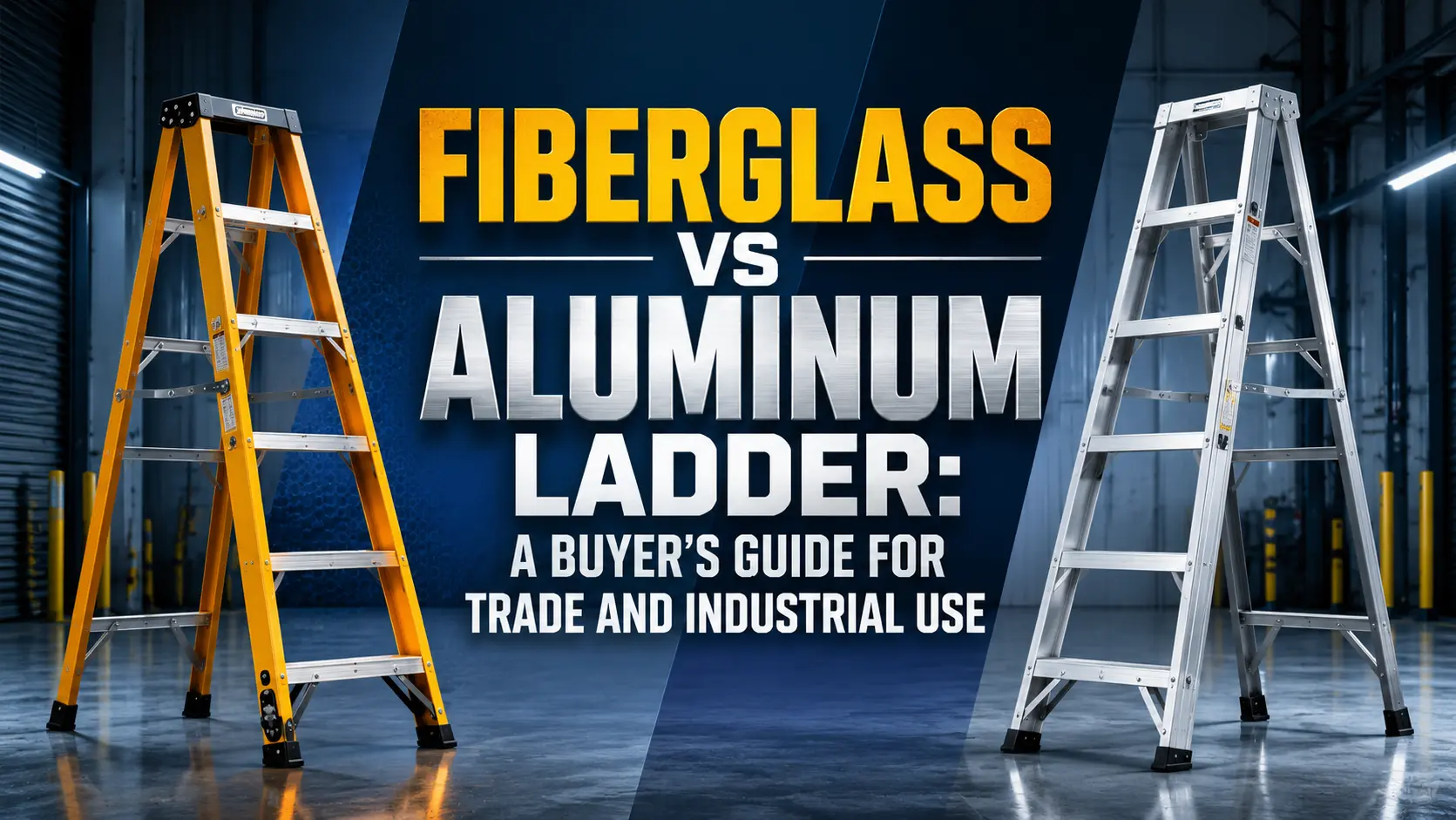
The right answer to the fiberglass vs aluminum ladder question depends on the work environment, not on a simple claim that one material is universally better. Fiberglass side rails are commonly selected where electrical exposure is a credible hazard. Aluminum ladders are often preferred where lower carrying weight, frequent movement, and efficient transport are priorities.
Professional buyers must look beyond material names. Ladder type, dimensions, condition, fittings, duty information, storage, inspection, user training, and local requirements all affect suitability. A fiberglass ladder that is wet, dirty, or damaged should not be treated as an electrical safety guarantee. An aluminum ladder that is easy to carry may still be the wrong choice near energized equipment or overhead lines.
This guide compares both materials from a procurement perspective, helping facilities teams, contractors, importers, and distributors build a product mix around real applications and lifecycle costs.
| Buying factor | Fiberglass ladder | Aluminum ladder |
|---|---|---|
| Electrical environment | Commonly chosen for nonconductive side rails, subject to product condition and applicable rules | Conductive; generally unsuitable where the ladder or user may contact exposed energized equipment |
| Carrying and repositioning | Often heavier than a comparable aluminum format | Often lighter and easier to move frequently |
| Corrosion considerations | Side rails resist rust, but fittings and other components still require inspection | Naturally corrosion resistant, but oxidation, chemicals, joints, and damage still matter |
| Surface condition | Dirt, moisture, damage, and conductive contamination can affect electrical risk | Contamination can create slip and corrosion issues; conductivity remains a core limitation |
| Outdoor use | Can suit outdoor work when the exact product and maintenance program are appropriate | Can suit outdoor work away from electrical hazards when stored and inspected correctly |
| Common buyer fit | Utilities, electrical maintenance, telecoms, industrial facilities | Warehouses, construction, retail maintenance, general trade, mobile service work |
| Fleet advantage | Helps separate equipment intended for electrical-risk environments | Reduces handling burden where teams reposition ladders repeatedly |
| Key purchasing risk | Overstating insulation or ignoring contamination and degradation | Allowing a conductive ladder into an electrical-risk task |
The table is a selection aid, not a model specification. Buyers should confirm the exact ladder’s permitted use, load information, dimensions, materials, labels, instructions, testing evidence, and destination-market requirements.
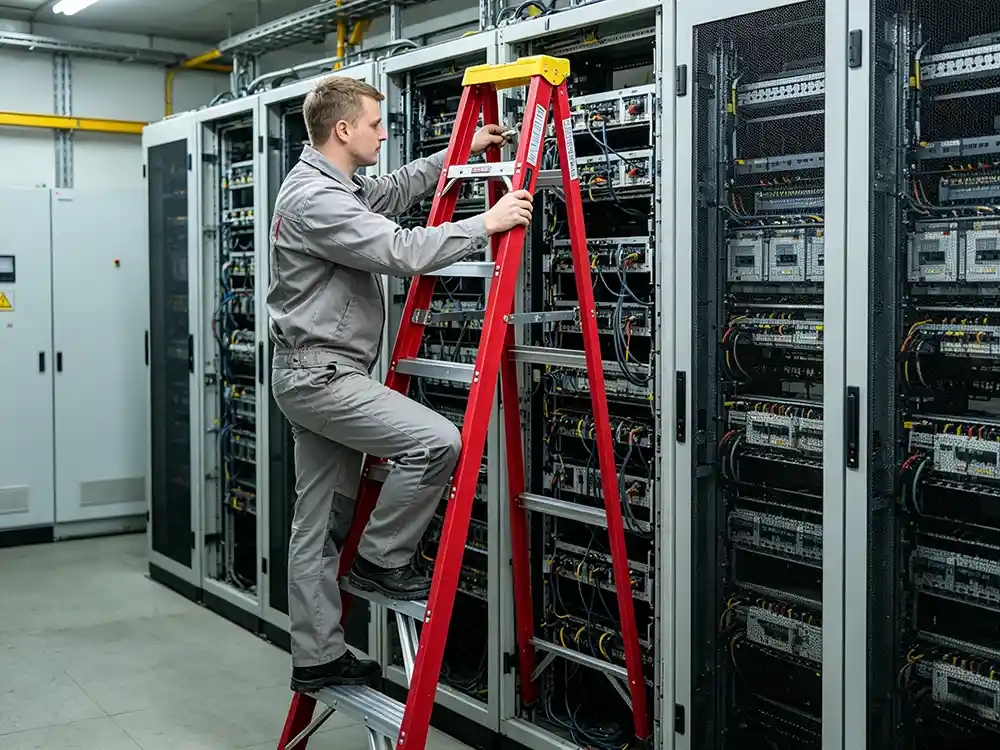
Where a worker or ladder could contact exposed energized equipment, electrical risk takes priority over convenience. In the United States, OSHA construction requirements call for nonconductive side rails in such circumstances, with specific provisions for specialized electrical work. Other countries apply their own legislation, standards, guidance, and safe-working-distance rules.
This does not mean that a fiberglass ladder makes energized work acceptable. The preferred control may be to de-energize, isolate, or maintain a required clearance from electrical equipment. Ladder selection is only one part of the risk assessment.
OSHA’s own power-line guidance warns that nonconductive side rails are an added precaution, not a guarantee. It also notes that fiberglass must be clean, dry, and undamaged. Buyers should carry this distinction into manuals, training, product pages, and sales claims.
Before specifying a fiberglass ladder for electrical work, confirm:
Importers should avoid marketing phrases that imply universal insulation. Use model-specific, evidence-based language reviewed for the destination market.
An aluminum ladder is often easier to carry than a comparable fiberglass ladder, but buyers should verify actual product weights rather than rely on a general rule. Dimensions, rail profiles, platforms, stabilizers, wheels, hinges, and accessories can change handling considerably.
For facilities or contractor fleets, weight affects more than user preference. It influences loading, unloading, roof-rack handling, movement through doorways, repositioning during a shift, and the number of people needed to control a long ladder.
Evaluate samples using realistic tasks:
Neither material should be described as maintenance-free.
Aluminum does not rust like carbon steel, but it can oxidize and may be affected by chemicals, salts, dissimilar-metal contact, damaged surfaces, and harsh storage. Inspect rails, rungs, joints, rivets, welds, feet, locks, and stabilizing components rather than looking only for red rust.
Fiberglass rails also require environmental care. Ultraviolet exposure, abrasion, impacts, cracking, surface wear, contamination, and moisture can affect condition. Metal fittings attached to a fiberglass ladder still need corrosion checks. A buyer should request the manufacturer’s cleaning, storage, inspection, and withdrawal-from-service instructions for each model.
For coastal, chemical, wastewater, food-processing, or other demanding sites, create an exposure profile before selecting material. Identify substances, cleaning agents, humidity, salt, temperature, storage, and inspection frequency. Ask the supplier to confirm material compatibility at product level rather than assuming that “corrosion resistant” covers every environment.
Good storage protects both ladder types from avoidable deterioration. Ladders should be restrained and supported so they are not bent, crushed, struck by vehicles, or exposed to incompatible chemicals. Storage should also keep them available for inspection rather than hiding critical areas behind other equipment.
An environmental pre-use check should cover:
Then inspect the ladder itself. Look for damaged feet, loose or missing components, bent or cracked rungs, rail damage, worn labels, contamination, corrosion, damaged joints, and any defect described by the manufacturer. Equipment with a defect affecting safe use should be identified and removed from service under the organization’s procedure.
Maintenance programs should be specific to material and ladder type.
Keep surfaces clean and dry using manufacturer-approved methods. Inspect for cracks, splits, exposed fibers, abrasion, discoloration, impact damage, surface degradation, and contamination. Do not paint or coat rails in a way that hides defects unless an approved repair or maintenance procedure explicitly allows it.
Electrical-risk users need clear criteria for when condition is uncertain. Field staff should not make improvised repairs or assume that a visually minor defect has no effect on performance.
Inspect for dents, bends, cracks, damaged welds or rivets, oxidation, sharp edges, and distortion. Check feet, rung connections, locks, ropes, pulleys, spreaders, hinges, and stabilizers as applicable to the ladder type.
Do not use an aluminum ladder near an electrical hazard merely because a surface coating appears intact. The underlying material remains conductive, and scratches, hardware, moisture, or accidental contact can defeat informal assumptions.
Unit price alone does not reveal which ladder produces better value. Build a total-cost model that includes:
Aluminum may reduce handling time and freight pressure in some programs. Fiberglass may justify higher logistics or handling costs when nonconductive side rails are a necessary part of the electrical-risk controls. Procurement teams should compare the whole application rather than trying to assign one material a lower universal lifetime cost.
The material decision does not replace the ladder-type decision. A buyer may need a step ladder for self-supporting low- or medium-height tasks, an extension ladder for leaning access, or a platform ladder for work requiring a more defined standing area.
Compare like with like. A lightweight aluminum step ladder and a long fiberglass extension ladder differ in structure and purpose as well as material. A fair evaluation should compare models with similar configurations, access ranges, duty information, and intended users.
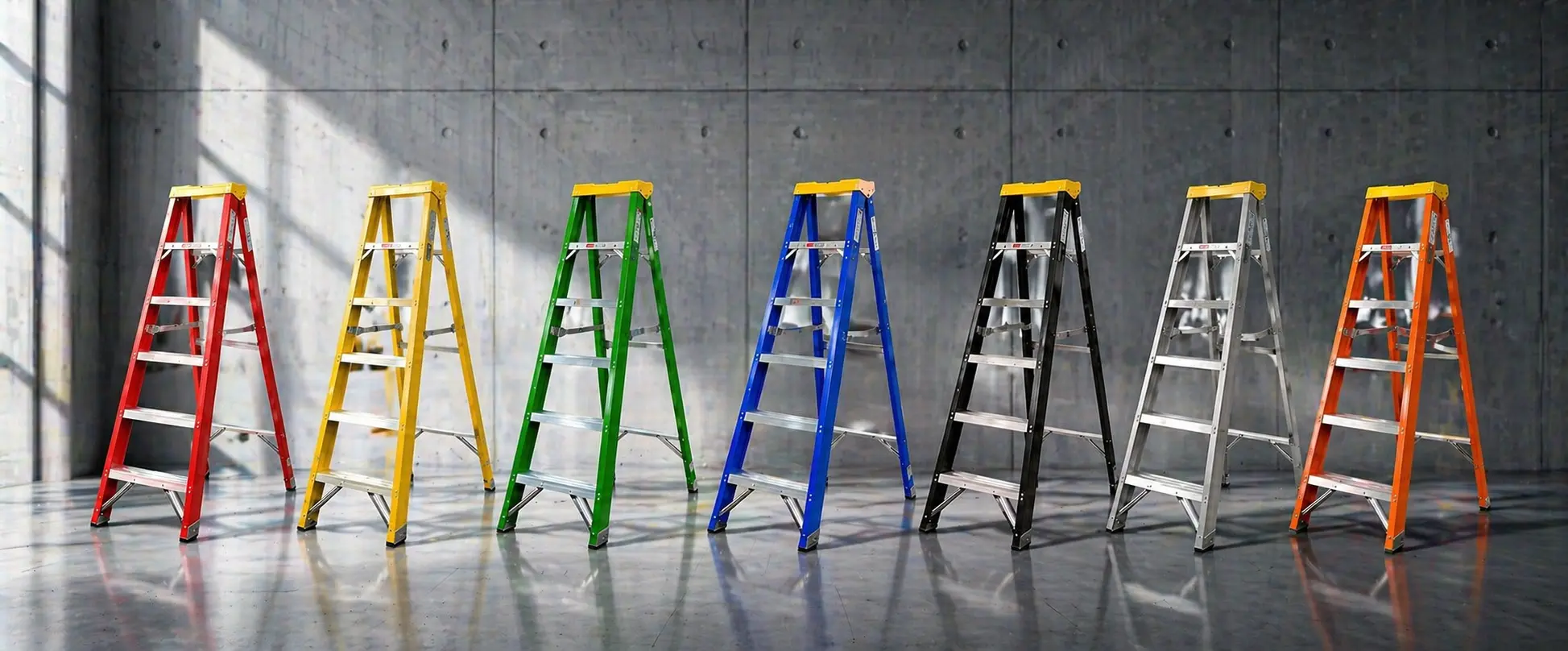
Fine Ladder’s live product range presents both aluminum and fiberglass options within step-ladder and extension-ladder categories. Buyers should confirm material, dimensions, features, documentation, and availability for each exact model before creating catalogs or quotations.
Many distributors should stock both materials instead of forcing one to serve every buyer.
Start by dividing demand into application groups:
| Buyer segment | Likely priority | Inventory direction |
|---|---|---|
| Electrical and utility contractors | Electrical-risk controls and documented suitability | Fiberglass-focused range, selected by task and local requirements |
| Telecom and facilities teams | Mixed environments and frequent maintenance | Combination of fiberglass and aluminum models |
| Warehouses and retail maintenance | Frequent indoor movement and compact storage | Aluminum-focused range where electrical exposure is not present |
| General construction and trades | Varied height, transport, and site conditions | Balanced range by ladder type, material, and working application |
| Coastal or industrial facilities | Corrosion, chemicals, storage, and inspection | Model-specific selection after environmental review |
Within each group, build a size and configuration ladder rather than stocking many near-duplicates. Track inquiries, lost sales, returns, and application questions. This data can show whether customers need more fiberglass extension ladders, lightweight aluminum step ladders, platforms, or other formats.
Train sales teams to ask about hazards before recommending a product. “How high do you need to reach?” is not enough. They should also ask where the ladder will be used, whether electrical exposure exists, how often it will be moved, what storage is available, and which market rules apply.
Before approving a product or supplier, confirm:
Use a production-representative sample and record the approved specifications, appearance, labels, manual, and packaging. Do not transfer a certification or performance statement from one model to another without evidence.
Choose fiberglass when the risk assessment and local requirements call for nonconductive side rails and the organization can keep the ladder clean, dry, undamaged, and correctly inspected. Choose aluminum where electrical exposure is not present and low weight, frequent carrying, and transport efficiency are stronger operational priorities.
For many professional suppliers, the practical fiberglass vs aluminum ladder strategy is a controlled mix. Electrical, utility, and industrial customers may need fiberglass models, while warehouse, retail, general maintenance, and mobile trade users may value aluminum. Fine Ladder offers both material categories across relevant ladder ranges. Share your industry, work environment, target market, required ladder type, and handling needs to discuss an appropriate procurement and inventory combination.
No. Fiberglass side rails are used as a nonconductive option, but moisture, dirt, damage, conductive contamination, fittings, and the work environment can affect risk. Maintain required electrical clearances and follow local rules, the risk assessment, and manufacturer instructions.
Often, but not always. Product format, height, rail construction, platform, stabilizer, hinges, and accessories affect weight. Compare verified weights for equivalent models.
Either may suit outdoor work when the exact model, weather, electrical hazards, surface condition, storage, and maintenance program are appropriate. Do not select material from a general corrosion claim alone.
Inspect rails for cracks, abrasion, exposed fibers, contamination, moisture, impact damage, and surface degradation. Also inspect rungs, feet, joints, locks, fittings, labels, and every component identified by the manufacturer.
Usually, if it serves varied professional sectors. A mixed inventory can address electrical-risk customers and buyers prioritizing lighter handling. Use inquiry and sales data to select ladder types, sizes, and quantities.