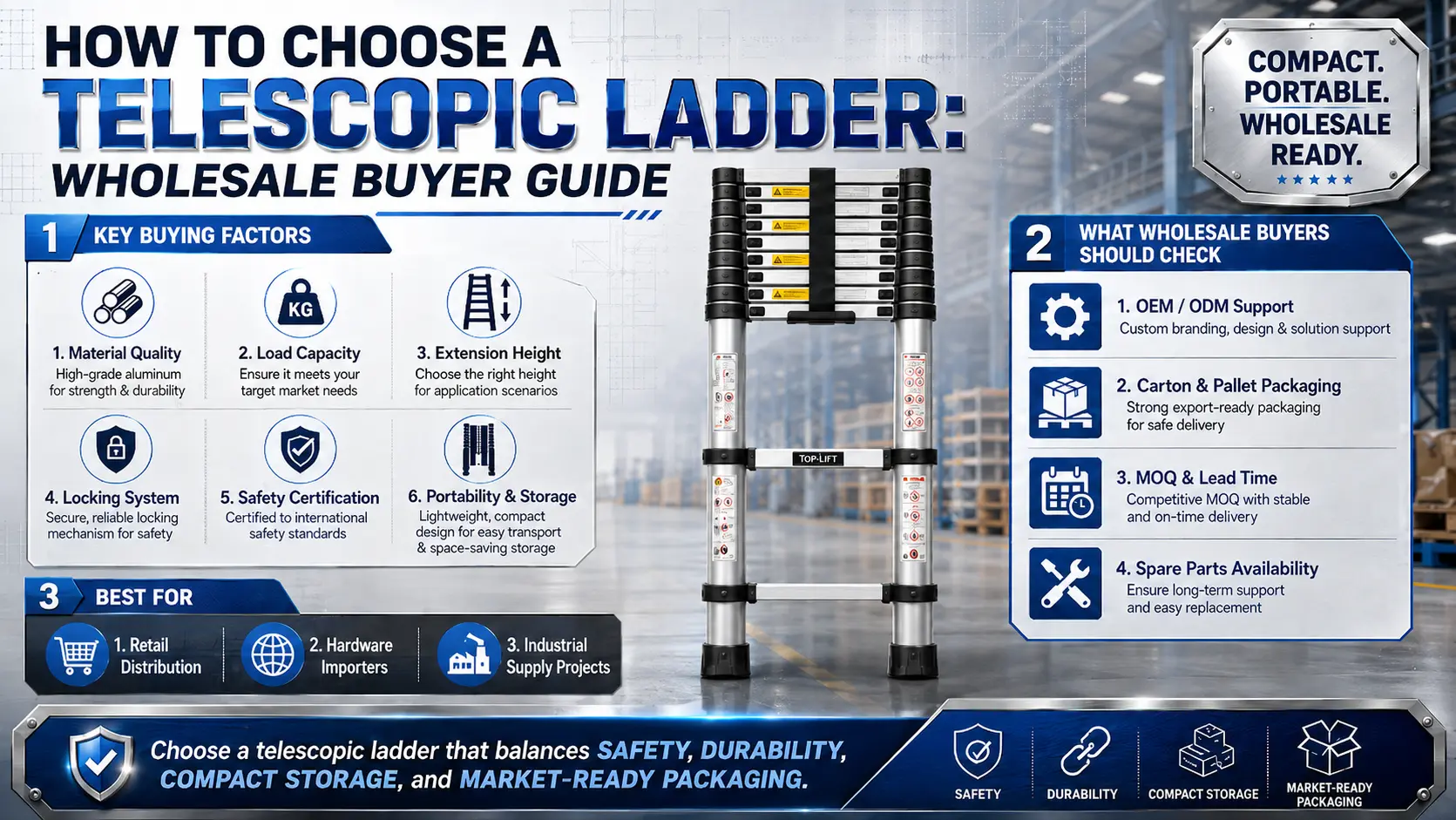
Knowing how to choose a telescopic ladder requires more than comparing extended height and purchase price. For wholesale and professional buyers, the decision should cover the complete product system: structure, locking operation, controlled retraction, closed dimensions, materials, user information, packaging, sample evaluation, and batch inspection.
A compact ladder may look convincing in a catalog but perform poorly if its locks are difficult to verify, its sections are vulnerable to contamination, or its packaging does not protect critical components in transit. The best procurement process begins with the intended market and application, then converts those needs into measurable product and quality requirements.
This guide focuses on the telescopic-specific details that importers, wholesalers, brand owners, distributors, and tool procurement managers should review. It does not replace the product manual, local regulations, applicable standards, or a task-specific risk assessment.
Before contacting a telescopic ladder supplier, define where, how, and how often the product will be used. A maintenance technician working from a compact service vehicle has different priorities from a rental fleet, warehouse team, contractor, or home-improvement distributor.
Create a short application profile covering:
Do not treat advertised ladder length as working height. Request a dimension drawing that separates closed length, maximum extended length, permitted intermediate positions, stabilizer width, product weight, and the manufacturer’s instructions on standing positions and access use.
Telescopic ladders are available in different structural formats. The correct choice depends on the permitted configurations and the task.
A single-sided model normally extends as a leaning ladder. It is often attractive where compact transport and access to an elevated surface are the main priorities. Buyers should examine the upper contact arrangement, feet, stabilizing components, section locks, and instructions for positioning and securing the ladder.
This format may suit mobile maintenance, inspection, cleaning, or service work when the environment provides a suitable supporting surface. It should not be marketed as self-supporting unless the exact product is designed, tested, documented, and approved for that configuration.
A double-sided telescopic model can offer a self-supporting configuration, depending on its design. It may be useful where no appropriate leaning surface is available or where buyers want adjustable access from an A-frame structure.
The added functionality also introduces more items to evaluate: hinges, spreaders or connecting mechanisms, locks on both sides, symmetry, base width, feet, and the sequence for opening and closing. Confirm every permitted configuration in the supplier’s documentation. Never assume a product can be used as an A-frame, straight ladder, stairway ladder, or multi-purpose platform merely because it resembles another model.
Nested sections are the defining feature of a collapsible ladder. They also create product-specific inspection points.
On a sample, extend and retract the ladder repeatedly according to the instructions. Observe whether sections move consistently without unusual resistance, looseness, misalignment, or abrupt motion. Inspect the tubes or rails for dents, distortion, sharp edges, inconsistent finish, and contamination. Check that rung-to-rail connections appear uniform and that end caps, guides, sleeves, and contact surfaces remain secure.
Ask the supplier how dust, sand, plaster, paint, moisture, and other contaminants affect operation. Cleaning instructions should be explicit. Buyers should not assume that oil or another lubricant can be applied; an unsuitable substance may attract dirt or affect internal components.
For wholesale programs, agree on visual defect limits and functional checks that can be repeated during production inspection. A vague requirement such as “smooth operation” is difficult to enforce. A better specification defines the approved sample, operating sequence, unacceptable symptoms, and inspection method.
A telescopic ladder contains multiple locking points. A buyer needs to understand how each section locks, how engagement is indicated, and how a user confirms the ladder is ready before climbing.
During sample evaluation, check:
Do not evaluate the lock only once. Repeat the complete cycle and include different permitted extension positions. If the model is designed for partial extension, the exact approved sequence and section arrangement should be documented.
Public product-safety reports show why these details matter: failures involving locking mechanisms, indicators, rung brackets, stability, markings, and documentation have led authorities to reject particular telescopic ladder products. These reports do not prove that every product has the same issue; they show why model-specific evidence and inspection are essential.
Retraction brings moving rungs and nested sections closer together. This creates potential trapping or pinch zones that must be managed through product design, operating sequence, warnings, and user behavior.
Evaluate how the ladder controls descent when release mechanisms are activated. Observe whether sections close progressively or can move suddenly. Review the location of release controls and the hand position shown in instructions and pictograms. Warnings should remain visible when the product is used, not disappear under packaging or labels.
For a private-label program, ask for clear demonstration media and user instructions. Training should show where hands may safely hold the ladder during extension and retraction. Avoid unqualified marketing claims such as “pinch-proof.” Even when a design includes spacing or controlled-retraction features, users still need to follow the approved process and keep hands away from closing zones.
Compact storage is a major reason buyers choose a telescopic ladder. Compare actual closed dimensions rather than relying on general terms such as portable or space-saving.
Measure the packed product and the unpacked ladder. Review carrying balance, grip locations, product weight, and any strap or closure used to keep sections together. Consider whether the ladder will fit across common service-vehicle layouts and whether it can be restrained so it does not move during transport.
For distributors, closed size also affects warehouse slots, parcel limits, retail presentation, and container utilization. A smaller package may reduce logistics pressure, but extra corner protection, molded inserts, or stronger cartons may be needed to protect locks, feet, rungs, and stabilizer components.
Material choice should be tied to actual use, not a simple ranking.
Aluminum is commonly chosen for portable access equipment because it can combine relatively low weight with corrosion resistance. It is conductive, so it is not suitable where the ladder or user could contact exposed energized electrical equipment. Buyers should confirm alloy, wall construction, finish, product weight, and model-specific documentation rather than make assumptions from the material name.
Fiberglass side rails are commonly considered for electrical applications, but the material is not a universal protection guarantee. Moisture, dirt, damage, conductive contamination, fittings, and the work environment remain important. Confirm the complete ladder design, care instructions, and applicable target-market requirements.
Stainless steel may be considered for particular corrosion, appearance, or structural requirements, but it can affect product weight and cost. Verify the actual grade, component construction, finish, maintenance needs, and intended application. Do not assume that every stainless-steel ladder is suitable for marine, chemical, or heavy-duty use without supporting evidence.
Fine Ladder’s live telescopic ladder range currently presents aluminum, fiberglass, and stainless-steel product types. Availability, specifications, configurations, and documentation should be confirmed at model level before publication or ordering.
A polished sales sample is not enough. Request a production-representative unit with the proposed materials, labels, manual, accessories, and packaging. Record its identity so it can serve as an approved reference.
Use a telescopic-specific sample checklist:
The number and nature of functional cycles, tests, and acceptance criteria should be defined with the appropriate technical and compliance specialists for the destination market. Do not invent a universal test plan.
Export packaging must protect more than the visible finish. A drop or concentrated impact can affect a rung, rail, lock, foot, indicator, or guide without producing dramatic carton damage.
Map the product’s vulnerable zones before finalizing packaging. Consider end protection, lock clearance, stabilizer separation, accessory containment, carton strength, internal movement, moisture exposure, stacking, and handling orientation. If components require assembly, make sure they cannot strike the ladder during transport.
Packaging validation should reflect the distribution route: factory handling, container loading, warehouses, parcel networks, retail handling, and final delivery. Agree on an applicable test method with a packaging professional instead of selecting a drop height at random. After testing, inspect both appearance and telescopic function; operating every lock is more informative than checking only the carton.
Bulk inspection should focus on the features that distinguish a telescopic ladder. A practical inspection plan may include:
| Inspection area | What to verify |
|---|---|
| Identity | Model, configuration, material, approved drawings, and order details |
| Dimensions | Closed size, extended size, stabilizer width, and packed dimensions |
| Telescoping function | Consistent section movement in approved configurations |
| Locks | Engagement, release, indicators, left-right consistency, and visible condition |
| Retraction | Controlled movement and correspondence with instructions |
| Structure | Rails or tubes, rungs, joints, hinges, guides, feet, and stabilizer |
| User information | Labels, warnings, manual language, model identity, and traceability information |
| Packaging | Carton, inserts, accessories, protection of locks and ends, and shipping marks |
Define sample size and acceptance criteria before production. Critical safety-related defects should not be treated like minor cosmetic variation. The inspection agreement should specify who makes disposition decisions, how rework is verified, and which records accompany shipment.
An effective request for quotation gives the supplier enough information to recommend a suitable model. Include:
Avoid choosing on unit price before confirming the specification. Differences in stabilizing components, locks, materials, labels, manuals, packaging, and quality controls can change both risk and landed cost.
When deciding how to choose a telescopic ladder, ask five final questions:
Fine Ladder offers telescopic ladder categories in aluminum, fiberglass, and stainless-steel constructions for international B2B buyers. Request the current catalog and share your target dimensions, material, packaging, destination market, and intended application so the relevant models and documentation can be compared before quotation or sample approval.
No single feature is sufficient, but locking consistency and clear engagement indicators deserve close attention. They should be evaluated together with the sections, rungs, feet, stabilizing components, instructions, and intended configuration.
It depends on the buyer segment. Single-sided models may suit compact leaning access, while double-sided models may serve customers needing an approved self-supporting configuration. Confirm demand, permitted uses, dimensions, training, and price positioning for each market.
Observe the complete retraction sequence, release controls, section speed, hand positions, rung spacing during closure, warnings, and instructions. Avoid absolute safety claims and ensure demonstration materials teach the approved procedure.
Inspect the carton and the complete ladder. Check rails, rungs, feet, stabilizer, hinges, guides, locks, indicators, accessories, labels, and telescoping operation. Hidden functional damage may matter even when cosmetic damage is limited.
Do not assume so. Target markets can differ in regulations, standards, markings, instructions, terminology, and commercial expectations. Confirm the complete product and documentation package for each destination.