Choosing warehouse steps starts with the work, not with the product name. Picking a carton, checking stock, changing a sign and conducting maintenance may all involve similar heights, but they place different demands on the user, the floor, the aisle and the equipment. A useful warehouse access range balances reach, platform position, movement, stored tools, storage footprint and the team’s inspection process.
Terms such as warehouse ladder, mobile safety steps, stock picking ladder, step ladder and podium do not always describe the same design across the United States, United Kingdom, Canada and Australia. Treat a label as a starting point only. The exact product instructions, workplace assessment and destination-market requirements determine how a particular product can be used.
Before comparing heights or materials, map the task. Ask what must be reached, how long a worker remains elevated, whether both hands are needed, what tools or stock are handled, how frequently the item is repositioned and who shares the aisle.
| Warehouse task | Access question to answer | Procurement focus |
|---|---|---|
| Order picking | Is the item small and light enough for the intended access method? | Step position, user movement, aisle clearance and product flow |
| Stock checks | Does the user repeatedly climb and descend at varied locations? | Compact footprint, carrying method and rapid inspection routine |
| Replenishment | Are cartons, scanners or labels handled at height? | Tool/material management and whether another access method is required |
| Light maintenance | Does the work require two hands, force or a more sustained position? | Platform option, task duration and escalation to another access solution |
| Retail display work | Is the area open to customers or foot traffic? | Area control, storage, visibility and relocation planning |
Do not use task duration as the only decision rule. A brief task can still be unsuitable for a ladder if it needs significant force, awkward materials or a crowded aisle. Conversely, a mobile activity may favor a compact product when the assessment and instructions support it.
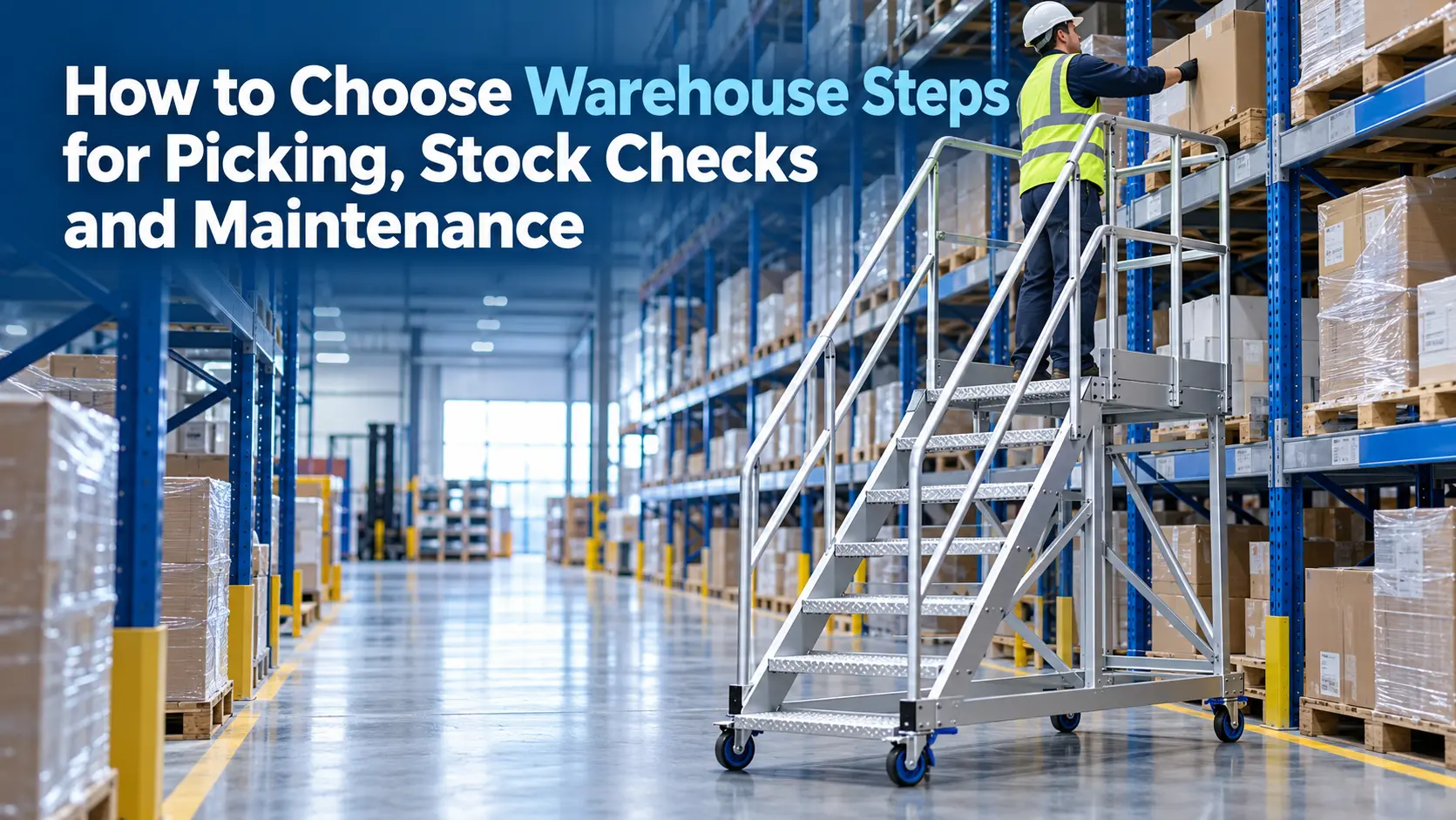
A conventional step ladder may suit brief access tasks on a firm, clear floor when the user can work without overreaching. A platform ladder can offer a defined standing surface and, depending on the exact model, additional hand support or a small storage feature. Mobile warehouse steps may be designed for repeated repositioning and stock work, but their travel and braking arrangements vary substantially.
“Podium” is also not a universal synonym. In one market it may imply a specific platform-and-guard arrangement; elsewhere, buyers may use it broadly for a platform ladder. Ask for drawings and instructions that show the platform, permitted standing area, handrails or guards, access side, feet, wheels and deployed footprint. Fine Ladder’s step ladder range and Towers & Podiums range can support a model-specific comparison.
Warehouse access equipment must fit the task location without reducing safe circulation. Measure the working aisle, not only the nominal racking gap. Include pallet positions, open doors, turning space, pedestrians, pallet trucks, forklift routes, emergency access, product overhang and the clearance needed to set up or reposition the equipment.
A product that fits when folded may require more space once opened. A platform, spreader, rail or stabilizing feature can change the deployed footprint. Wheels can also change the approach and turning space. Request closed dimensions and deployed-footprint information for each shortlisted model, then test a sample in representative aisles.
If an aisle cannot safely accommodate the equipment and traffic at the same time, change the work plan. Do not solve the problem by narrowing the working position, removing components or asking workers to operate in a live traffic path.
Smooth concrete can still be unsuitable if it is wet, dusty, oily, damaged, uneven or obstructed by loose wrapping and debris. Check the condition of floor joints, ramps, loading zones, temporary coverings and threshold transitions. The equipment’s feet, wheels and any braking components must be evaluated against the actual surface and manufacturer instructions.
For warehouse steps that move on wheels, clarify how the product is intended to travel, how it is intended to stand for use and how any brake, lock or weight-activated feature operates. Do not assume that a wheel automatically locks under load, or that a brake is suitable for every floor. Test the defined operating sequence using the exact model and retain the instructions with the product data.
Mobility is useful only when controlled. During sample approval, operate the wheels and braking mechanism repeatedly on a representative surface. Confirm the user can tell when the product is in its intended working state, and inspect the wheels, axles, feet, fasteners and controls for damage or unusual movement.
Ask suppliers and internal users these questions:
Never describe a mobile product as “self-securing” unless this is verified for that exact model and the claim is appropriate for the target market. Clear user instructions and a controlled work area remain necessary.
A platform can help define a work position, but it does not make prolonged or forceful work risk-free. Buyers should review platform size, surface, opening mechanism, lock arrangement, permitted standing area and the surrounding support structure. A rail or handhold may assist the user but should not be marketed as full edge protection unless the product documentation and local requirements explicitly support that description.
Tool trays and holders should be assessed separately. They may reduce repeated trips for small items, but capacities and permitted contents vary. A tray should not become an improvised platform, and stored items must not interfere with climbing, folding or a secure grip. For bulky stock, repeated carton handling or two-handed installation, reassess whether warehouse steps are the right equipment.
Plan where warehouse steps wait between tasks. A product left in an aisle, emergency route, fire point or charging area becomes a site-management issue. Assign a storage location that protects the equipment from forklift contact, falling stock, water and contaminants while allowing staff to inspect it before use.
Closed dimensions matter for racking, cupboards and vehicle delivery, but storage should also allow wheels, feet and rails to avoid deformation. Do not stack pallets or heavy goods on folded equipment. Keep instructions and inspection tags available to the users who issue or return the steps.
For multi-site operators, a simple asset identifier and condition label can make handover easier. The process should record location, product type, condition, missing parts and whether a repair or replacement review is needed.
Rather than buying one height for every task, group demand by common picking height, aisle type, floor condition, mobility frequency and task duration. A distribution centre may need compact step ladders for short checks, platform products for defined maintenance tasks and a separate solution for heavier or longer work. Retail backrooms may prioritize folded footprint and controlled storage. Industrial facilities may prioritize task documentation and compatibility with site procedures.
Request the following before confirming a SKU plan:
Fine Ladder’s retail and warehouse sector page can help frame a category discussion. For a targeted recommendation, use the contact page to share aisle width, floor condition, picking height, movement frequency and target market.
The right warehouse steps are the product that fits a defined task, physical aisle and controlled work process—not simply the tallest or most mobile option. Compare terminology carefully, trial the equipment on representative floors, examine wheels and brakes as model-specific mechanisms, and build a SKU mix around real picking and maintenance patterns. Good selection reduces improvisation and gives workers a clearer, more repeatable access process.
Review the range whenever warehouse layouts or tasks change.