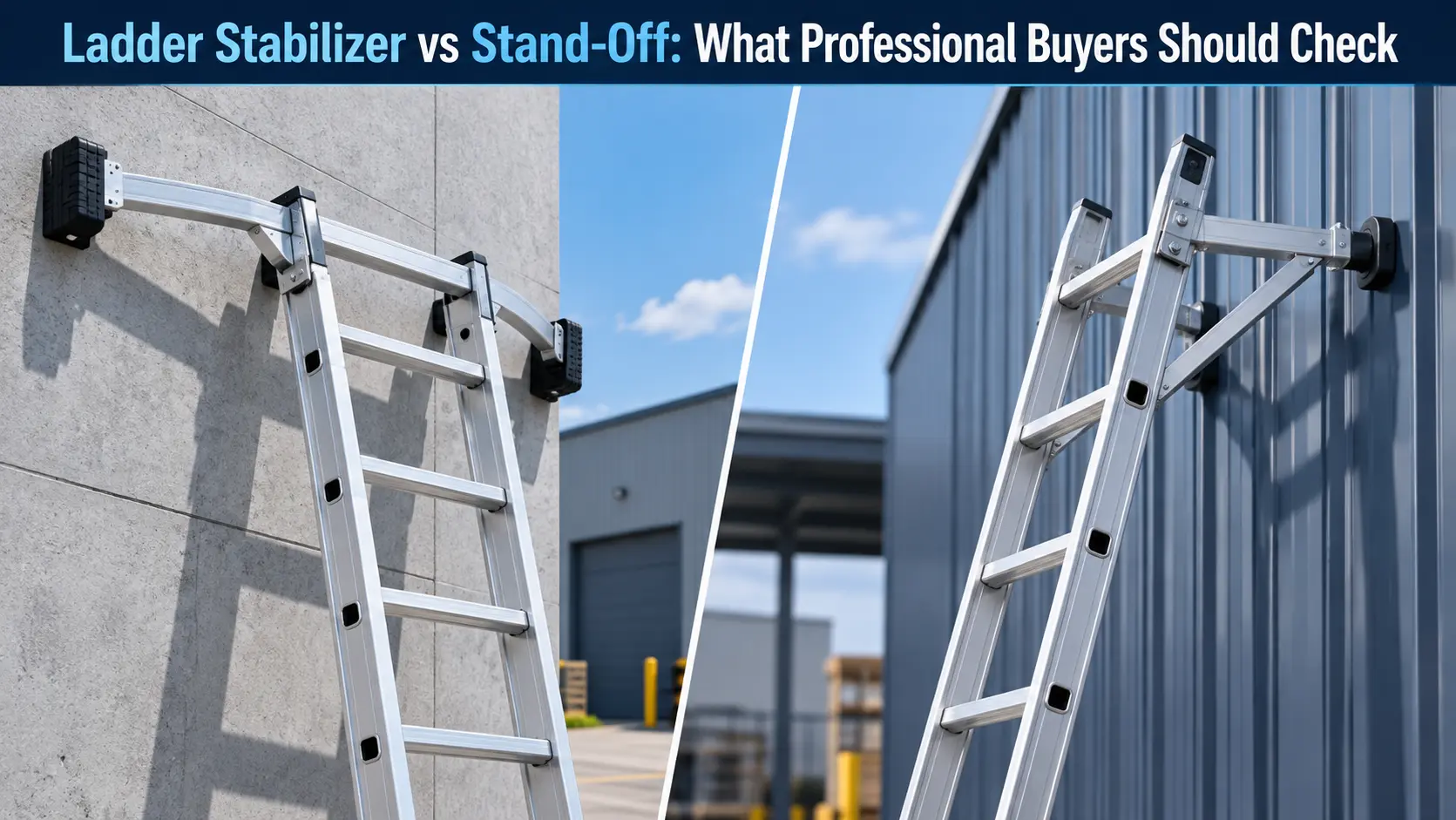
In a ladder stabilizer vs stand off comparison, terminology can be less consistent than buyers expect. Both expressions are often used for an accessory fitted near the upper end of a ladder to create separation from a wall, roof edge or obstacle. However, the actual design, attachment method, compatible ladder types and approved uses vary by product. A familiar name is never proof that an accessory fits a particular extension ladder.
For professional buyers, the right question is: what does the exact accessory do with the exact ladder model in the intended task and market? This guide helps importers, dealers, roofing contractors and facilities teams evaluate that question. It does not replace the ladder manual, accessory instructions, a work-at-height assessment or local requirements.
“Stabilizer” can refer broadly to a part intended to improve support or widen a contact arrangement. “Stand-off” commonly emphasizes creating a gap between the ladder and the surface it contacts. In product listings, the words may be used together, separately or for products with different shapes. Some accessories may be intended to clear eaves, gutters, projections or uneven wall features; others may be designed for a more specific ladder system.
Avoid writing a generic claim such as “fits all extension ladders” or “makes roof work safe.” Ask for a model-specific drawing, instructions, mounting points and compatibility list. Confirm whether the item is supplied with the ladder, optional for a stated series, or only available as part of a defined system. Fine Ladder’s extension ladder range and accessories page are useful starting points for a product discussion, not evidence of universal interchangeability.
A stand-off arrangement may help keep the top of an approved ladder away from a surface feature and create a different contact position. That can be relevant around eaves, gutters, shallow projections or a wall area where direct contact is unsuitable. It does not decide whether the ladder is the right access equipment, whether the base is secure, whether the upper support is sound, or whether the task can be done without overreaching.
The work still needs a suitable ladder length, approved setup, controlled area and task plan. Weather, fragile surfaces, overhead hazards, access to a landing, traffic and work force all influence the decision. An accessory cannot compensate for a bent rail, damaged foot, unsuitable ladder, poor ground or a task that needs a platform or another access method.
Treat compatibility as a specification, not a sales assumption. During sample review, confirm the ladder family, rail profile, attachment points, ladder width, fastening method, closed-length effect and the configurations allowed by the instructions. Examine whether installation changes how the ladder is carried, stored or placed on a vehicle rack.
Ask the supplier for these items:
Do not drill, modify or adapt an accessory to make it fit unless the manufacturer specifically instructs that action. A field modification can affect the ladder, invalidate the instruction basis and make the final configuration impossible to support commercially.
Installation should follow the exact accessory instructions. Before a dealer demonstrates or a user deploys the combination, inspect rails, mounting points, fasteners, pads and the accessory structure for damage, distortion, missing parts or contamination. Confirm that locks or retaining parts are fully engaged as the manual describes.
Position the ladder only after assessing the base, upper contact arrangement and task area. The stand-off should contact only the surfaces and in the manner the product documentation permits. Do not use an accessory to bridge a gap, rest on a fragile gutter, create an improvised roof support or support materials.
After positioning, recheck the entire system before climbing. The ladder, accessory and work area can change during transport or adjustment. If the fit is uncertain, a part is damaged, instructions are unavailable or the setup does not match the approved configuration, stop and obtain direction rather than improvising.
The space created by a stand-off is often the reason buyers seek the accessory, but it should not become a fixed published promise. Clearance depends on accessory design, rail fit, ladder angle, contact surface and task. Do not publish a universal wall gap or eave clearance without verified product data.
For roofing and facilities work, evaluate the actual obstruction: gutter material, eave geometry, cladding, windows, fragile finishes, roof edge and access route. The most useful sample test is a controlled review against representative site conditions, performed according to the supplier’s instructions and the buyer’s safety process. Document what was tested and what remains outside the product’s approved use.
An accessory can change the practical value of a ladder fleet. Check whether it remains fitted during vehicle transport, needs removal before storage, adds snag points or requires separate packing. Protect pads, fasteners and attachment areas from impacts with other ladders or tools. A damaged contact pad or distorted bracket may not be obvious in a closed vehicle rack.
For dealer inventory, use clear carton and part identification. Keep the compatibility list with product data, sales training and order records. At goods-in, check count, carton condition, hardware completeness, instruction version and obvious damage. At return or rental inspection, check the same points before issuing the accessory again.
Dealers do not need to stock every accessory with every ladder. Start with customer applications: roofing crews may require a different range discussion from facilities-maintenance teams or general trade users. Identify the most common extension-ladder models, target markets, storage systems and recurring site obstacles. Then offer only accessories with confirmed fit and clear user information.
| Buyer question | Procurement evidence to request |
|---|---|
| Does it fit our ladder? | Model-specific compatibility and installation instructions |
| Can sales staff explain it? | Product diagram, inspection points and approved task descriptions |
| Will it survive our logistics path? | Carton details, component protection and sample handling review |
| Can we list it responsibly? | Confirmed product claims, warnings and target-market documentation |
| Is another access method better? | Task description, site conditions and project risk assessment |
Before purchasing, invite Fine Ladder to compare the ladder type, target application, market and accessory requirement through its contact page. This creates a model-specific compatibility discussion rather than an assumption based on a generic term.
Ladder stabilizer and stand-off are useful search terms, but neither is a universal product category or a universal safety upgrade. A professional buyer should confirm model fit, installation, contact surfaces, instructions, transport and inspection requirements before adding an accessory to a ladder range. The strongest SKU decision is the one that matches an approved ladder-and-accessory combination to a real customer task.