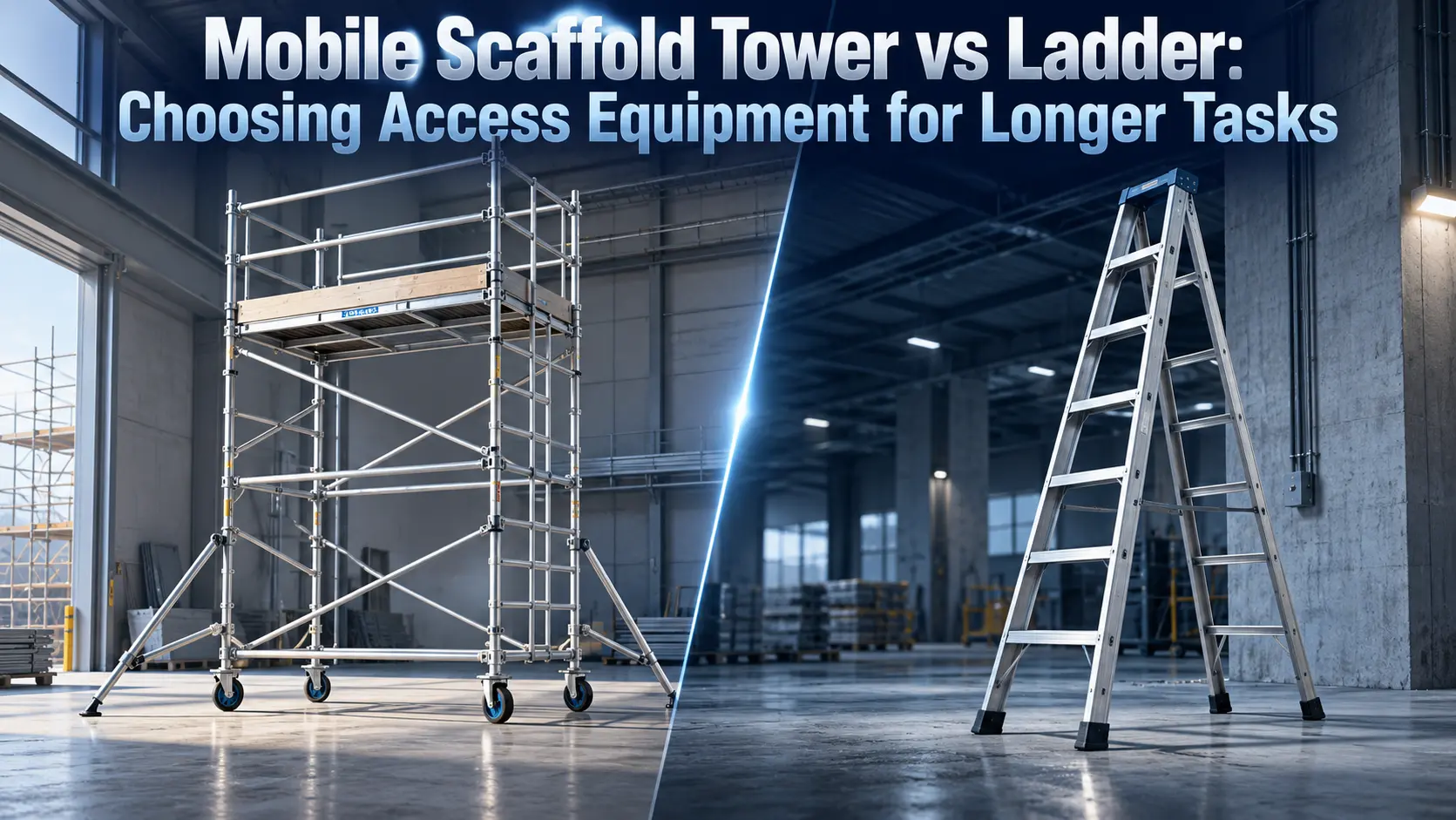
In a scaffold tower vs ladder decision, the key issue is not which product is universally safer. It is which access method fits the work: its duration, height, working area, force, tools, materials, movement and site conditions. A ladder can be an efficient solution for brief, low-risk access tasks. A mobile scaffold tower or a podium-style working platform may be more suitable when the job needs a defined standing area, two hands for work, repeated lateral reach or more materials at height.
This is a planning guide for project buyers, not a replacement for a site-specific risk assessment, product instructions, competent supervision or local work-at-height requirements. Tower systems, platform arrangements and ladders vary by model and destination market. Verify the exact product documentation before selecting, hiring, assembling or listing a product.
| Decision factor | Ladder | Podium or platform ladder | Mobile scaffold tower |
|---|---|---|---|
| Task duration | Often suits brief, light access tasks where a ladder is justified | Useful for a more defined work position during limited tasks | Often considered where work is longer, repetitive or needs a platform area |
| Working position | Climbing and standing restrictions depend on the model | Defined platform and support features vary by product | Platform-based work area, subject to the exact system and rules |
| Lateral work range | Limited; reposition rather than overreach | More defined but still limited working zone | Can support work across a wider local area, within platform limits |
| Tools and materials | Carrying and storage are restricted by task and instructions | May include a tray or small storage feature | May allow task materials on the platform only where the system permits |
| Setup | Usually fast but still requires an inspection and stable positioning | Fast-to-moderate setup depending on design | Assembly, inspection and competent management are required |
| Ground and space | Needs firm footing and suitable upper support when leaning | Needs a clear, level footprint | Needs a suitable base, space for stabilizing components and controlled movement |
| Transport | Typically compact and simple to carry | May be bulkier than a basic ladder | Components, packaging, loading plan and site access require more planning |
The right-hand column is not an automatic upgrade path. A tower can be unsuitable in constrained spaces, on poor ground or where assembly and inspection cannot be managed. Likewise, a ladder should not be retained merely because it is familiar or quicker to unload.
Project teams sometimes ask for “a ladder” before defining the work. A better brief describes the contact height, work duration, number of operatives, tools, materials, force applied to the work, frequency of relocation and space around the workface. This makes it easier to compare a ladder for maintenance with a working platform or access tower.
For example, a short inspection or a limited adjustment may be compatible with a suitable ladder after assessment. A job involving repetitive drilling, installing multiple fittings, handling materials, working with both hands or covering a broad section of wall presents a different access question. The worker may need a stable working position, space for task items, more controlled edge conditions or an alternative such as a tower or mobile elevating work platform.
Do not turn duration into a fixed rule. A short task can be high risk because of force, traffic or surface conditions, while a longer task may need a tower because frequent ladder repositioning itself creates disruption. Evaluate the whole work method.
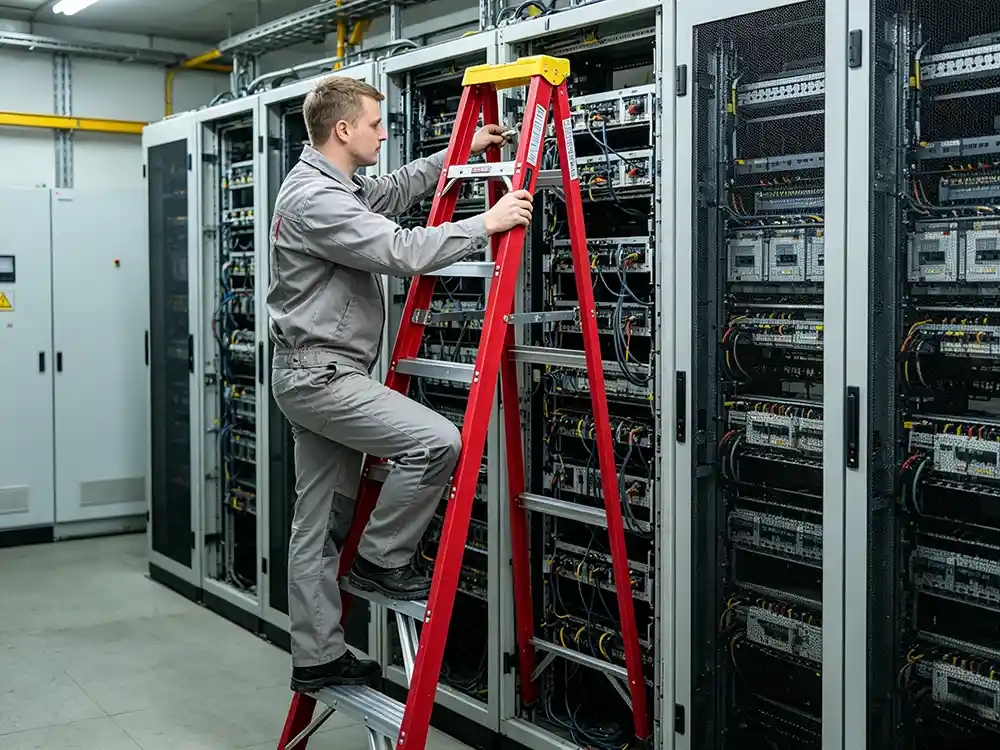
Step ladders and extension ladders can be practical when the work is brief, the user can maintain an appropriate position, the task does not require significant side force or bulky materials, and the ground and support conditions are suitable. A ladder may also reduce setup time for distributed tasks across a large building, where a tower would need repeated assembly or relocation.
The selection must stay model-specific. A step ladder is self-supporting only in its approved deployed condition. A leaning or extension ladder needs a suitable upper support and correct setup. Standing positions, tool handling, access-to-landing and securing requirements must come from product instructions and the applicable local framework—not from a generic comparison article.
Fine Ladder’s step ladder range and relevant extension ladder options should be compared using actual dimensions, permitted configurations, material, labels and workplace needs. Do not assume that a category name gives every model the same capability.
A podium or platform ladder can offer a more defined standing position than an ordinary step ladder. Depending on the design, it may include a platform, handrail, guard structure or tool tray. These features can improve task organization for certain maintenance or finishing activities, but they do not grant unlimited duration, unrestricted reach or automatic edge protection.
Buyers should check the platform surface, access route, lock or spreader arrangement, hand-support structure, permitted standing areas, folded profile and setup footprint. The task should still allow the user to work facing the job without leaning sideways. Where a project involves repeated movement along a wall, a platform ladder may reduce some climbing disruption but may still be inefficient compared with a tower.
For facilities management teams, a small range of carefully selected ladders and podiums can cover mobile, short-duration tasks. Fine Ladder’s Towers & Podiums page is a useful product-category starting point; final suitability depends on the exact model and project plan.
Consider a mobile scaffold tower when the task needs a larger working area at height, two-handed work, repeated lateral access, more task material, or a more sustained position than a ladder can reasonably support. Examples may include continuous interior finishing, repeated installation work, inspection across a local ceiling or wall zone, and some facility-maintenance projects.
Before choosing a tower, confirm that the site can support it. Check the base surface, doorways, corridors, ceiling obstructions, service lines, wind exposure where relevant, storage of components, delivery access and the route for any relocation. If the tower is moved, procedures on whether it must be clear of people and materials, how it is secured and what conditions permit movement must follow the system manual and local rules.
Assembly is a management issue as well as a product issue. The project should define who assembles, alters and inspects the tower; how components are identified; how incomplete assemblies are prevented from use; and how pre-use and post-alteration checks are recorded where required. Do not quote platform heights, certification claims or component counts unless confirmed for the selected system.
The need to use both hands is an important signal that access should be reassessed. On a ladder, a worker often needs to climb with a secure grip and work within a narrow position. Tools may need to be carried differently, raised separately or stored only in manufacturer-approved features. Bulky, heavy or awkward items can change the risk profile quickly.
A tower or working platform may provide more room for task materials, but it also has limits. Verify the platform’s permitted loading, the storage arrangement, the clear access route and whether materials introduce trip, falling-object or side-loading hazards. Never treat a platform as general storage simply because it has more area than a rung.
Procurement teams should ask operational users what they actually carry: hand tools, fixings, cable, paint, test equipment, duct components or replacement parts. This often reveals whether the selected access equipment supports the work sequence or forces unsafe improvisation.
Every access option depends on its base. Ladders require firm footing; leaning ladders also require a secure upper bearing point. Podiums need enough clear floor area for their deployed footprint. Towers need a base and surrounding clearance suitable for their system, stabilizing arrangement and use. A smooth indoor slab does not guarantee a suitable site if it is wet, contaminated, obstructed or exposed to vehicle movement.
Review door swings, walkways, public areas, forklifts, overhead services, uneven surfaces, temporary floor covers and restricted escape routes. A tower may consume too much circulation space; a ladder may create a conflict in a narrow aisle; a podium may be a workable middle option. Control measures must be selected by the project team, not guessed from a product description.
Ladders are often attractive because they are quick to carry and store. Towers require component management: frames, platforms, braces, stabilizers, guard components, instructions and inspection records may all need to travel together. Evaluate closed sizes, component protection, van or truck loading, warehouse locations, site delivery and the risk of missing parts.
Hire companies and distributors should build a simple issue process. It can include component identification, condition checks, clean and complete packaging, instructions, user information and a return inspection. For ladders, examine rails, rungs, feet, locks, spreaders and labels. For towers, verify that the system is complete and that damaged or mixed components are not issued as an assumed compatible set.
For facilities teams and project buyers, Fine Ladder’s facilities-management sector page can help frame the product discussion. Send the task, working height, ground condition, movement frequency and platform requirements through the contact page to compare practical access options.
A scaffold tower vs ladder choice should follow the work, not habit. Ladders can be effective for suitable short tasks; podiums can support a more defined position; mobile towers can address longer, broader or more material-intensive work where the site and management arrangements allow. The strongest decision combines product-specific information with a real project assessment, competent setup and clear inspection responsibilities.
No. Each option has conditions where it may be suitable or unsuitable. The task, site, product instructions, setup quality and local requirements determine the appropriate choice.
Consider it when work needs a larger standing area, two-handed operation, repeated lateral access, more materials or a more sustained work position, subject to site and system suitability.
Sometimes it may fit a limited, mobile task, but it does not automatically provide the work area or capability of a tower. Compare the exact product and task requirements.
Check that the correct system components, instructions, labels and inspection records are complete and that no component is damaged or assumed compatible without confirmation.
Provide the task, working height, duration, ground condition, space constraints, movement frequency, tool and material needs, team size and target market.