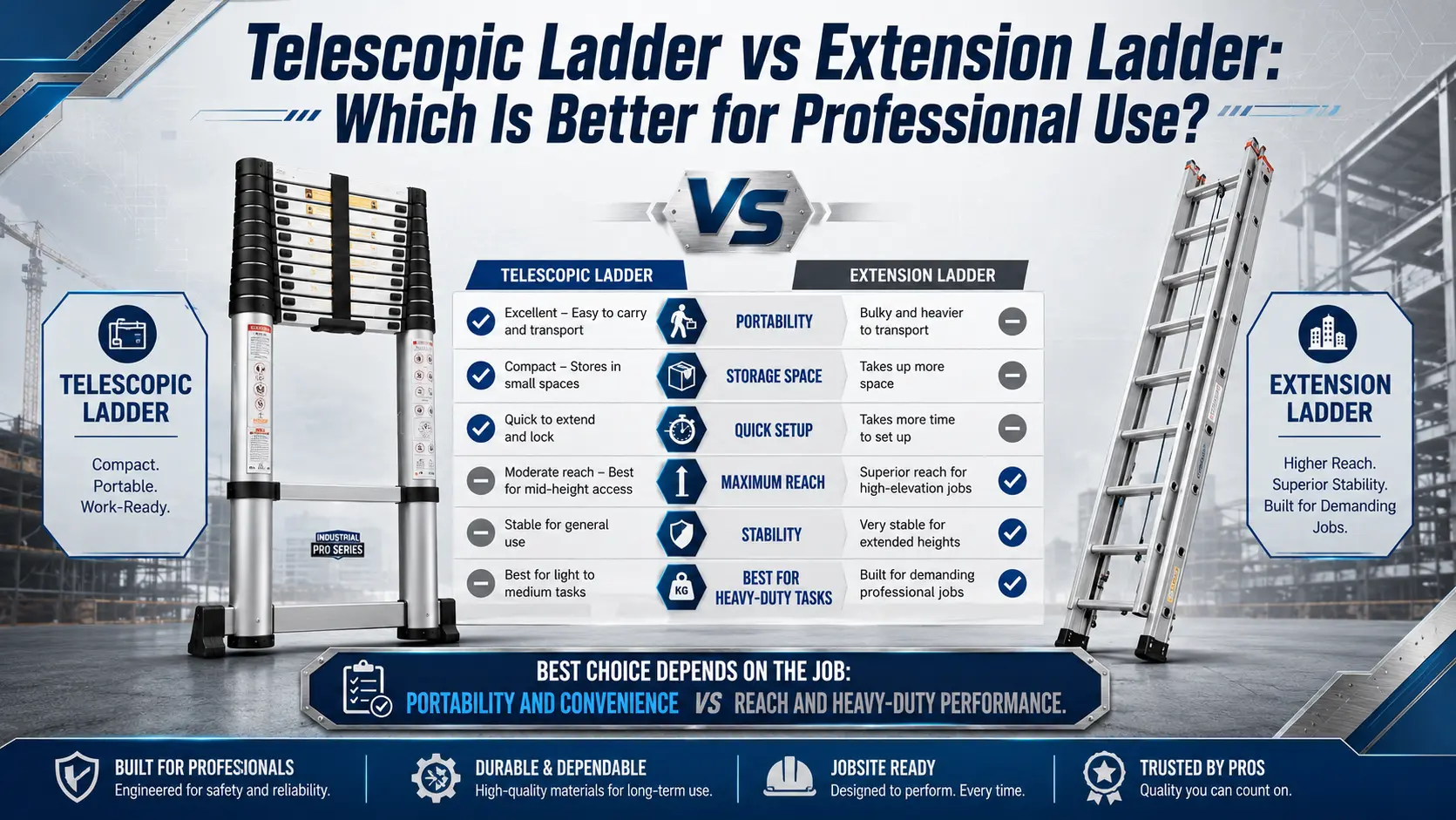
When comparing a telescopic ladder vs extension ladder, there is no universal winner. A telescopic ladder is usually the stronger candidate when compact storage, vehicle space, and fast movement between locations are priorities. A conventional extension ladder is often more suitable when users need repeated access at greater heights, a familiar setup process, or a straightforward fleet asset for regular site work.
For professional buyers, the right decision depends on more than maximum length. Transport conditions, deployed dimensions, setup frequency, inspection routines, materials, replacement parts, and local requirements all affect whether a ladder will perform well throughout its service life. This guide explains the practical differences so importers, distributors, hire companies, contractors, and facilities teams can compare products on a consistent basis.
Safety note: A ladder should only be selected after a task-specific risk assessment confirms that it is suitable. Users must follow the product instructions and applicable local regulations. Neither ladder type is automatically safer in every situation.
| Decision factor | Telescopic ladder | Conventional extension ladder |
|---|---|---|
| Storage | Collapses into a short package | Remains relatively long when closed |
| Vehicle transport | Useful where cargo space is limited | Often needs a rack, long van, or dedicated storage position |
| Height adjustment | Sections typically extend in controlled increments | Fly sections extend along guides, often using a rope on longer models |
| Deployment | Compact to carry, but every locking point must be confirmed | Requires room to raise and position the ladder safely |
| Component complexity | Multiple telescoping tubes and locking points require careful inspection | Fewer sliding interfaces, but rung locks, rope, guides, and shoes still need inspection |
| Cleaning sensitivity | Dirt or damage can affect telescoping movement and locks | Dirt can affect rails and guides; ropes and pulley components may also wear |
| Typical buying advantage | Portability and space efficiency | Reach, familiar operation, and suitability for repeated planned access |
| Best fit | Mobile technicians, compact fleets, service vehicles, space-limited storage | Construction, facilities, utilities, maintenance, and repeated access tasks |
This table is a starting point, not a substitute for reviewing the exact model. Buyers should compare closed length, deployed length, permitted configurations, ladder weight, duty or load information, locking indicators, feet, stabilizers, labels, packaging, and instructions for each product under consideration.
A telescopic ladder uses nested sections that slide inside one another. Its main advantage is the ratio between deployed length and closed size. This makes it a practical portable ladder for service vehicles, property maintenance, inspection teams, and buyers serving customers with limited storage.
A conventional extension ladder normally has two or more long sections. The upper section moves along the lower section to increase reach. Its closed length is greater than that of a comparable collapsible ladder, but the structure and operating sequence are familiar to many professional users.
Transport is one of the clearest differences between these ladder types.
A telescopic ladder can free space inside a service van, utility vehicle, warehouse, or retail stockroom. Its shorter closed package may also simplify carrying through corridors, lifts, stairways, and occupied buildings. For field technicians who complete several short visits per day, that compact format can be more important than maximum reach.
However, compact does not mean effortless. Procurement teams should compare the actual closed dimensions and product weight, not only promotional descriptions. They should also consider handles, securing points, packaging, and how workers will prevent the ladder from moving inside a vehicle.
An extension ladder may make sense when a contractor already operates vans with suitable racks or dedicated ladder storage. In that setting, its longer closed length may not create an additional operational problem. A fleet manager may instead value quick identification, familiar deployment, and compatibility with existing inspection or storage processes.
The number printed in a product name may describe total length, deployed length, or another commercial measurement. It does not necessarily equal safe standing height or usable working height.
Buyers should request a dimension sheet that clearly distinguishes:
Telescopic ladders are attractive when users need several height settings from one compact unit. Conventional extension ladders can be a better fit where longer, repeated access is expected and transport space is available. In either case, buyers should match the product to the actual contact point, access level, user position, and surrounding hazards.
The setup process affects both usability and training.
A telescopic model relies on a series of sections and locks. Before climbing, the user needs to confirm that the ladder is fully deployed in an approved configuration and that every required locking point is engaged. Indicators must be visible and understandable under realistic site conditions.
During product evaluation, buyers should check whether the operating sequence is intuitive, whether warning labels remain visible, how the ladder controls section movement, and how hands are kept away from closing zones. The product manual should explain extension and retraction without ambiguity.
A conventional extension ladder needs enough clear space for raising, extending, placing, and securing it. Users must inspect the rung locks and, where fitted, the rope, pulley, guides, feet, and stabilizing components. Both side rails need suitable support when the ladder is placed.
The familiar appearance of an extension ladder should not lead to casual setup. Selection and positioning still need to follow the manufacturer’s instructions, site risk assessment, and applicable regulations.
It is misleading to say that one ladder category is always more stable. Stability depends on the complete system: ladder dimensions, feet, stabilizer design, structural condition, ground, upper contact, setup, securing method, user behavior, weather, and task.
A compact telescopic ladder may be convenient in a crowded facility, but all locking points must function correctly. A long extension ladder may provide the required reach, but it must be positioned on a suitable base with appropriate upper support. An unsuitable surface or incorrect setup can undermine either design.
Professional buyers should therefore evaluate:
A telescopic ladder has multiple nested sections and locking components. Inspection should follow the manufacturer’s instructions and typically focus on visible damage, contamination, smooth section movement, lock operation, feet, rungs, labels, and loose or missing components. Cleaning methods and permitted lubricants—if any—must come from the manufacturer rather than improvised site practice.
Sand, plaster dust, paint, moisture, and impact damage can affect moving interfaces. Buyers serving construction or maintenance markets should ask how the product is cleaned, dried, stored, and withdrawn from service after damage.
An extension ladder also needs structured checks. Areas may include rails, rungs, shoes, rung locks, guides, fasteners, rope, and pulley components where fitted. Storage should protect the ladder from vehicle damage, contamination, avoidable weather exposure, and distortion.
Material selection should follow the work environment and local requirements.
Aluminum is widely used where low weight, corrosion resistance, and frequent handling are valued. It is conductive, so it is not appropriate where the ladder or user could contact exposed energized electrical equipment.
Fiberglass or glassfibre side rails are commonly considered for electrical work, but buyers must not treat the material as a blanket safety guarantee. Dirt, moisture, damage, conductive contamination, hardware, and the work environment still matter. Users must follow applicable electrical-safety procedures.
Some telescopic products use stainless steel for particular applications. Buyers should verify the actual grade, weight, corrosion environment, construction, and intended use rather than assuming that stainless steel is automatically the best value.
The material decision should be made at model level. Ask for confirmed specifications and evidence applicable to the target market before making performance or compliance claims.
For mobile technicians making many visits, a compact ladder may reduce loading time and preserve vehicle space. For teams repeatedly accessing similar elevations on planned sites, a conventional extension ladder may integrate more naturally with established work methods.
Equipment hire companies should consider how easily staff can inspect the product between rentals, explain its operation, identify misuse, replace wear components, and record defects. Distributors should consider whether end users will understand the difference between overall length and permitted working positions.
A useful cost comparison includes more than the quoted ladder price. Buyers should model:
A telescopic ladder may reduce storage and transport pressure. An extension ladder may deliver better value where reach and repeated deployment dominate the use case. The preferred option is the one that produces the most reliable operational fit—not simply the smallest carton or longest advertised length.
Before requesting a quotation or approving a sample, confirm the following:
For bulk procurement, evaluate a production-representative sample using a documented checklist. Record the approved specifications, packaging, labeling, instructions, and visible quality points before confirming the order.
Choose a telescopic ladder when compact storage, easy vehicle transport, and adjustable length are central to the job. Choose a conventional extension ladder when repeated access, longer reach, and an established transport and setup process matter more than closed size.
For many distributors and hire fleets, the answer may be a product mix rather than a single category. Compact telescopic models can serve mobile and space-limited users, while extension ladders support applications where reach and regular site deployment are the priority.
The most useful telescopic ladder vs extension ladder comparison starts with the task, not the product label. Fine Ladder supplies telescopic and extension ladder categories for international B2B buyers. Share your target market, required working range, vehicle or storage limits, expected frequency of use, and application environment to discuss which models should be compared for your catalog or project.
Neither type is automatically safer. Suitability depends on the product, condition, setup, ground, securing method, task, user competence, and local requirements. Telescopic locks and sections require careful checking; extension ladder locks, rails, feet, and any rope system also require inspection.
A telescopic ladder usually has the advantage when closed storage length is limited. Buyers should still compare actual closed dimensions, weight, carrying method, and how the ladder will be restrained during transport.
No. Its compact design can solve many mobile-access needs, but reach, permitted configurations, frequency of use, work environment, and inspection capability may favor a conventional extension ladder or another access system.
Check dimensions, section movement, every locking point and indicator, rungs, rails, feet, stabilizing components, labels, instructions, packaging, and visible finish. Use the manufacturer’s inspection criteria and confirm all target-market requirements before ordering.
Confirm deployed and closed dimensions, permitted working positions, materials, rung locks, ropes and pulleys where fitted, feet, stabilizers, labels, instructions, packaging, inspection criteria, and the documentation required for the destination market.